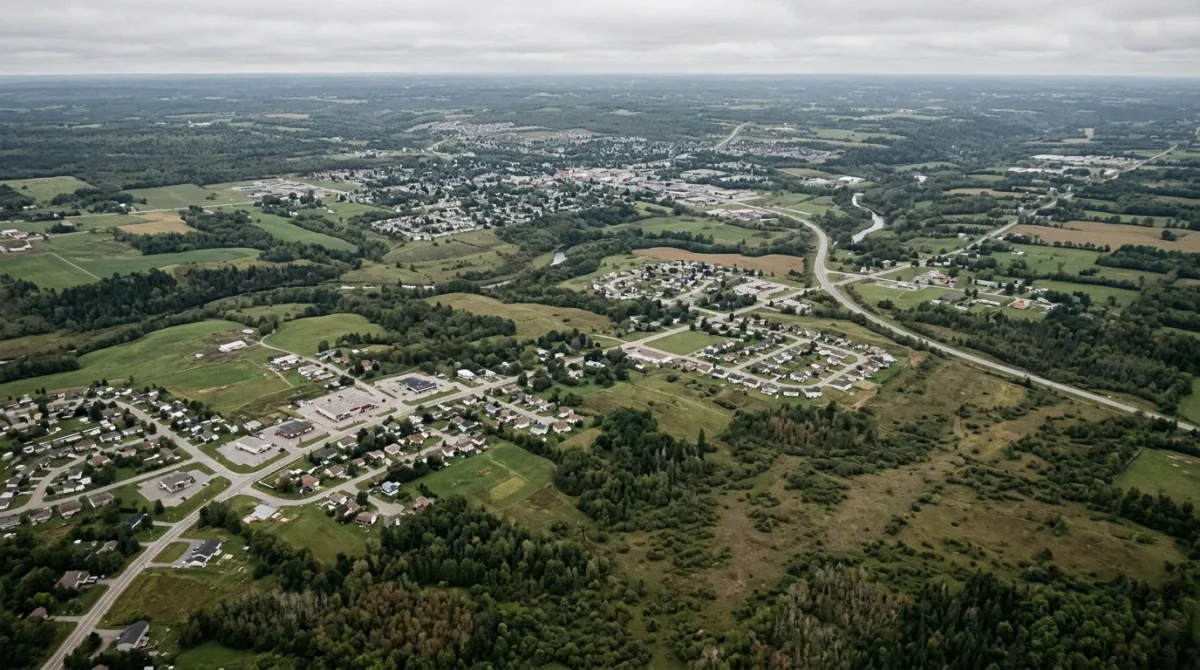
A news desert is a U.S. county with no locally based news outlet at all, not simply one with too few reporters. Northwestern University's Medill Local News Initiative counted 213 such counties in its 2025 State of Local News report, up from 206 the year before, with roughly 50 million Americans living in counties that have limited or no access to local news.
The count gets cited constantly in funding pitches and conference panels, often loosely. But the researchers behind it apply a specific, if imperfect, method, and knowing what it does and doesn't measure matters for anyone reporting on local news' health or arguing for a newsroom's relevance to its county.
Where Did the Term Come From?
The phrase predates the current tracking effort. The Center for Innovation and Sustainability in Local Media at the University of North Carolina's Hussman School of Journalism and Media, which began publishing county-level reports in 2016, defines a news desert as "a community, either rural or urban, with limited access to the sort of credible and comprehensive news and information that feeds democracy at the grassroots level."
That definition has two working parts: a supply problem, where metro papers pull back rural and suburban coverage and circulation shrinks, and a demand problem, where readers stop engaging with a newspaper that has become a thinner version of itself. The UNC center's own language for this second case is blunt — some papers still publish but have become "ghosts of their former selves."
How Does Medill Decide a County Qualifies?
Medill's Local News Initiative, which now leads the annual national count, applies the plainest version of the test: a county qualifies as a desert if it has zero locally based news sources, print or digital. The 2025 report identified 213 such counties, and separately flagged 1,524 additional counties that have exactly one remaining outlet, typically a weekly newspaper serving a wide radius.
The project also maintains a "watch list" of counties judged at high risk of losing their last outlet within the next decade — 250 counties in the 2025 report. Watch-list status isn't a prediction of closure; it's a flag built from ownership instability, staffing cuts, and publishing-frequency reductions that the research team has documented case by case.
What Counts as an Outlet That "Saves" a County From the List?
This is where the count gets more contested. UNC's methodology, developed for its Expanding News Desert project, treats a "ghost newspaper" as a separate category from a closed one: a paper that still exists on paper but has been hollowed out. Researchers there identified two patterns — weeklies converted into shoppers, ad supplements, or lifestyle specialty publications, and larger metro and regional dailies that kept publishing while sharply cutting newsroom staff and local government coverage.
The practical consequence for anyone using the desert count as a health indicator: a county with one surviving outlet is not automatically a county with adequate coverage. Medill's single-source category and UNC's ghost-newspaper category exist precisely because "has a newspaper" and "has functioning local accountability journalism" are not the same claim, even though they get conflated in casual use of the term.
What Does the Closure Pace Look Like Right Now?
The underlying trend driving all of this is closures, not just desert formation. Medill's 2025 report counted 136 newspaper closures or mergers in the prior year, a pace the researchers describe as more than two per week. Since 2005, roughly 3,500 U.S. newspapers have disappeared, representing about 40 percent of the local newspapers that existed then. Newsroom employment nationally has fallen more than 75 percent over the same period.
Closures aren't purely a rural story. Medill's 2025 findings noted that nearly 70 percent of the past year's closures occurred in predominantly urban counties, even though close to 80 percent of the standing news desert counties are rural — a split worth knowing before assuming "desert" and "closure" describe the same geography.
What Does This Look Like for an Actual Newsroom?
The abstractions play out in specific closures. In one recent case covered by PBS News Hour, News Media Corporation shut down 23 news operations across five states, a collapse the network's reporting tied to the company's deep financial troubles. Teri Finneman, a University of Kansas journalism professor and co-author of "Reviving Rural News," discussed the closures on air as an example of how quickly a multi-title chain can go from operating to gone, taking a cluster of counties' only remaining coverage with it.
For editors and funders, the transferable point isn't the specific company. It's that desert counts are usually a lagging indicator — a chain's closures register in the national data only after the fact, which is part of why the watch-list category, built from staffing and ownership signals rather than closure announcements, has become the more operationally useful number for anyone trying to intervene before a county loses its last outlet, according to Medill Local News Initiative's 2025 State of Local News report.
For a related media news perspective, read Comprehensive Invisalign Care: Maintaining Your Clear Aligners for Optimal Results.
For more context, read What a News Desert Actually Measures — and What It Misses.
For more context, read What the Local News Desert Numbers Actually Show.