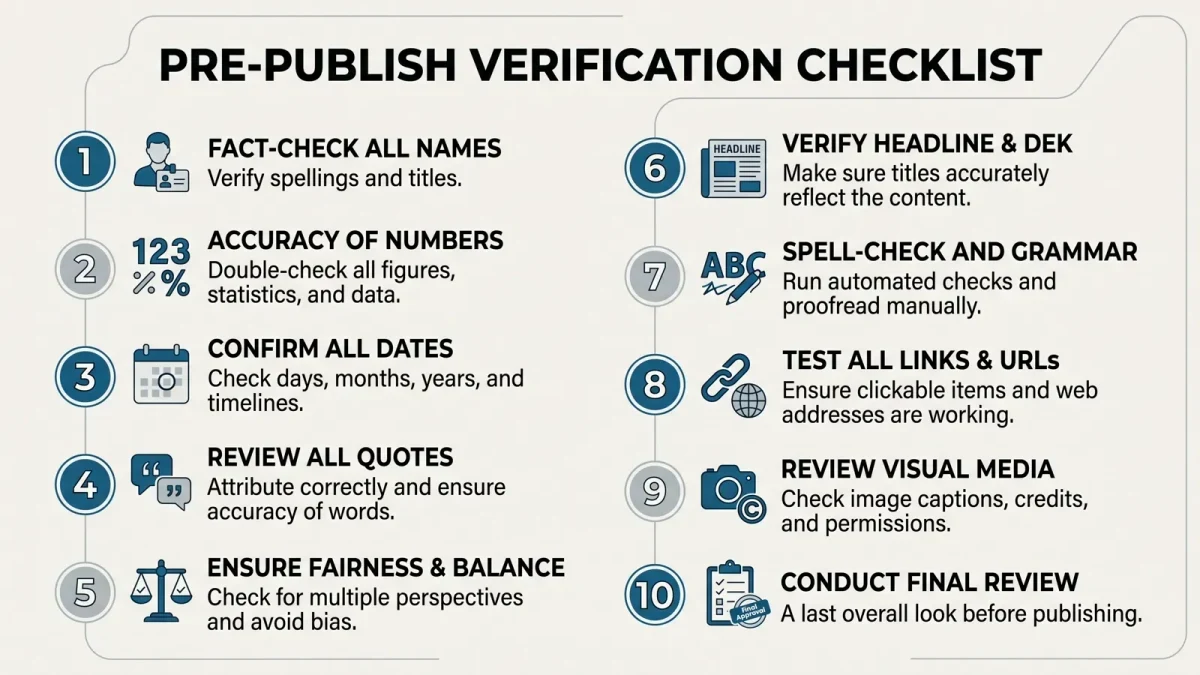
The fastest verification is the one you run before the story is filed. A single-editor desk cannot duplicate a wire service's review layers, but it can run a ten-point check that takes about fifteen minutes on a standard local story and catches the errors that actually trigger corrections. The International Fact-Checking Network's published standards, used by verified fact-checking organizations worldwide, rest on the same principle the checklist applies: every factual claim traces to a source you can show.
What are the ten checks?
Run them in order; each takes a minute or two on most stories:
- Names: every person's name spelled and capitalized as they write it — ask, do not assume.
- Titles and roles: current as of today; last month's title is this month's correction.
- Numbers: recompute every figure from the source document; check the unit (millions, per-cent, per-thousand).
- Dates and days: the date exists, and the day of the week matches the calendar.
- Places: addresses exist and sit in the right jurisdiction — the neighboring county's courthouse is a classic error.
- Quotes: exact wording against the recording or notes, in context, with ellipses marked.
- Claims of fact from sources: attributed, not asserted in the newsroom's voice.
- The other side: everyone criticized or accused has been contacted, and the story says what happened when they were.
- Links and documents: every cited document opens and says what the story says it says.
- Headline and dek: both claims survive the story's own qualifiers — the correction is often in the story and missing from the headline.
Why does the order matter?
The sequence moves from mechanical to judgment-based. The first six checks are binary — right or wrong — and can run even when the editor is tired. The last four require the judgment the first six protected: by the time you evaluate fairness, you are no longer worried about whether the basic facts hold. Editors who run the list backwards tend to debate framing while a misspelled name sits underneath it.
How do you verify when the source is a viral video?
Reverse the pressure: the more widely a clip is spreading, the more suspicious to be of its packaging. Minimum steps before citing user-generated footage: confirm the earliest version you can find, geolocate visible landmarks against mapping tools, check weather and shadows against the stated date, and contact the original uploader directly. Agence France-Presse and the BBC's verification units publish their methodology openly, and the core of it — earliest version, location, date, uploader — is achievable from a laptop anywhere.
What gets logged after publication?
Every correction, in one place, with the check that would have caught it. After a month the log tells you your newsroom's specific failure pattern — most desks discover that two of the ten points cause most of their errors. The checklist is then shortened, not abandoned: a check that never catches anything can move to the long list reserved for high-stakes stories.
When should the checklist stop a story entirely?
When checks eight or nine fail — no contact with the criticized party, or a cited document that will not open — the story waits. A verification checklist that cannot hold a story for an hour is a suggestion, not a standard. Editors who publish anyway, on deadline, should at least be choosing to do it, with the failure named in the story rather than discovered by a reader.
Frequently asked questions
Does the checklist apply to short items?
Yes, faster. A 200-word brief runs the list in five minutes, and briefs are disproportionately corrected precisely because they skip it.
Can a reporter verify their own copy?
On a one-person desk, yes — the checklist is designed for that. The discipline is that the list is completed as a separate pass, after the draft is finished, never during writing.
What about anonymous sources in verification?
Checks seven and eight still apply with extra weight: the unnamed source's claim is tested against documents and a second source before publication, because the reader cannot do that testing later.