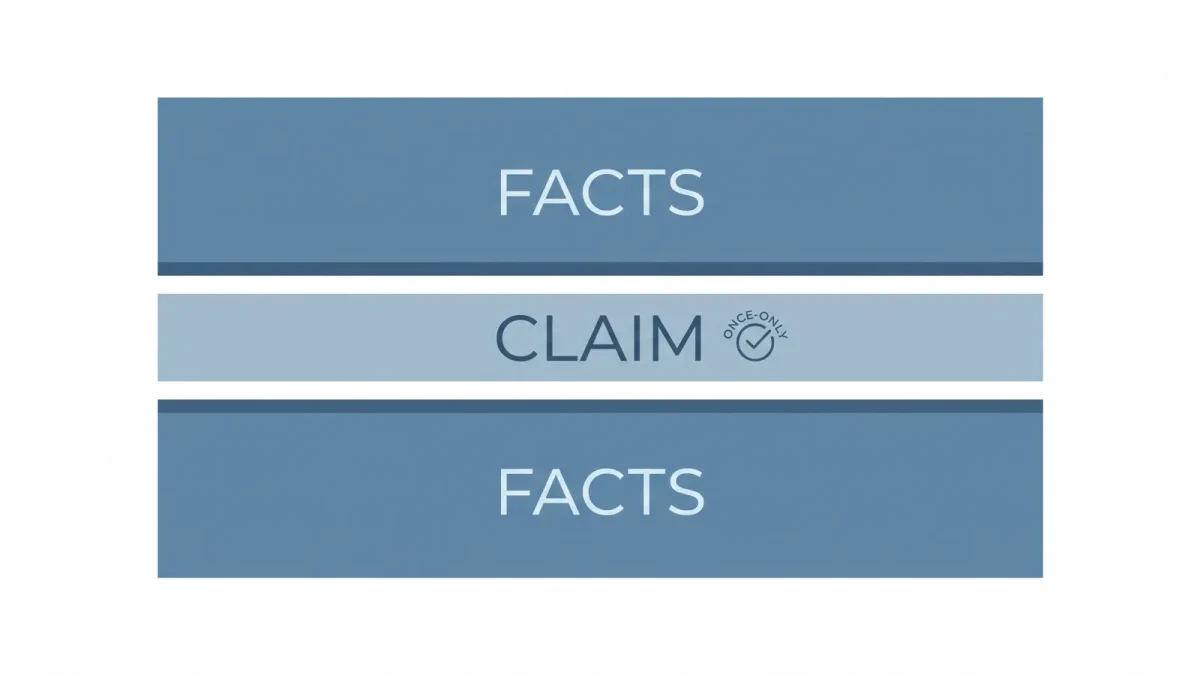
The working answer to false election claims is structural: report the truth first, state the falsehood once in context, and close with the truth again — the "truth sandwich" approach associated with research from the University of Cambridge's credibility group and widely adopted in newsroom guidance after 2020. Every editorial choice in election coverage either repeats a false claim to new audiences or contains it; the difference is technique, not courage. Local newsrooms carry the heavier duty: in most American communities, the local outlet is the only institution residents will trust to say who won.
What are the structural rules?
- Headlines never carry the false claim. The headline is the most repeated sentence a newsroom produces; a false claim in a headline outlives every correction.
- Truth first: lead with what is true — the certified result, the audited count — then state the claim, attributed and limited, then return to the facts.
- State the claim once. Repetition builds familiarity, and familiarity builds belief — the best-documented finding in misinformation research.
- Name the evidence, not the adjective: "false" and "baseless" should be conclusions the story demonstrates, with the documents one paragraph away.
What is pre-bunking, and why does it work better than debunking?
Pre-bunking explains the manipulation before audiences meet it: how counts legitimately shift as mail and provisional ballots are processed, why races are called by decision desks, what a recount actually does. Inoculation-style messaging — explaining the technique of a falsehood in advance — has shown measurable resistance effects in published studies, and election pages that explained counting timeliness in 2020 and 2024 measurably reduced the information vacuum that false claims filled. The local version is a standing explainer published weeks before each election and linked from every race story: how we count, when we report, why numbers change.
How should a local outlet cover a local claim?
The same rules at local scale, with one addition: cover the process, not just the dispute. When a candidate questions a county result, the story is the county's actual process — the chain of custody, the public test of tabulation equipment, the statutory audit — documented so residents can see the machinery their neighbor distrusts. Local officials' own published procedures and the U.S. Election Assistance Commission's resources provide the factual spine; the reporter's job is to make the spine visible to a lay reader.
When does a claim deserve coverage at all?
A threshold test, stated plainly in newsroom policy, prevents the amplification trap. Coverage is warranted when the claim comes from someone with institutional power over the process, has reached an audience where it can cause action, or alleges a specific, checkable fact. Claims failing all three tests get nothing — not a story, not a quote in another story, not a social reply. The discipline that kills most outlets is coverage driven by what opponents of the newsroom will say if it stays silent; the answer to that pressure is the published threshold, applied identically to all parties.
What about the aftermath — audits, recounts, litigation?
Cover outcomes as facts with history attached. Recounts that confirm counts, audits that find error rates measured in fractions, lawsuits dismissed — reported plainly, they are the strongest truth sandwich available, because they are the system demonstrating itself. Local outlets that maintained running audit-result pages found them among the most-cited items in the following cycle. And the final rule: never fake-update. An explainer gets a date and a revision date; an old story stays as published with a link forward. Visible, truthful dating is itself a trust practice in election coverage.
Frequently asked questions
Doesn't refusing to repeat claims censor one side?
The policy is content-neutral: any claim from any party meets the same threshold. What readers get is more information about the process, not less about the dispute.
How should social posts handle the rules?
Stricter than the story — a platform post is headline-scale and travels without context. The truth-first structure applies with double force; many newsrooms never state the false claim in social copy at all.
What if the false claim wins locally — a board acts on it?
Then it is news of official action, covered as governance: what the board did, on what stated basis, with the factual record attached. The coverage follows power, and the sandwich structure still governs the framing.