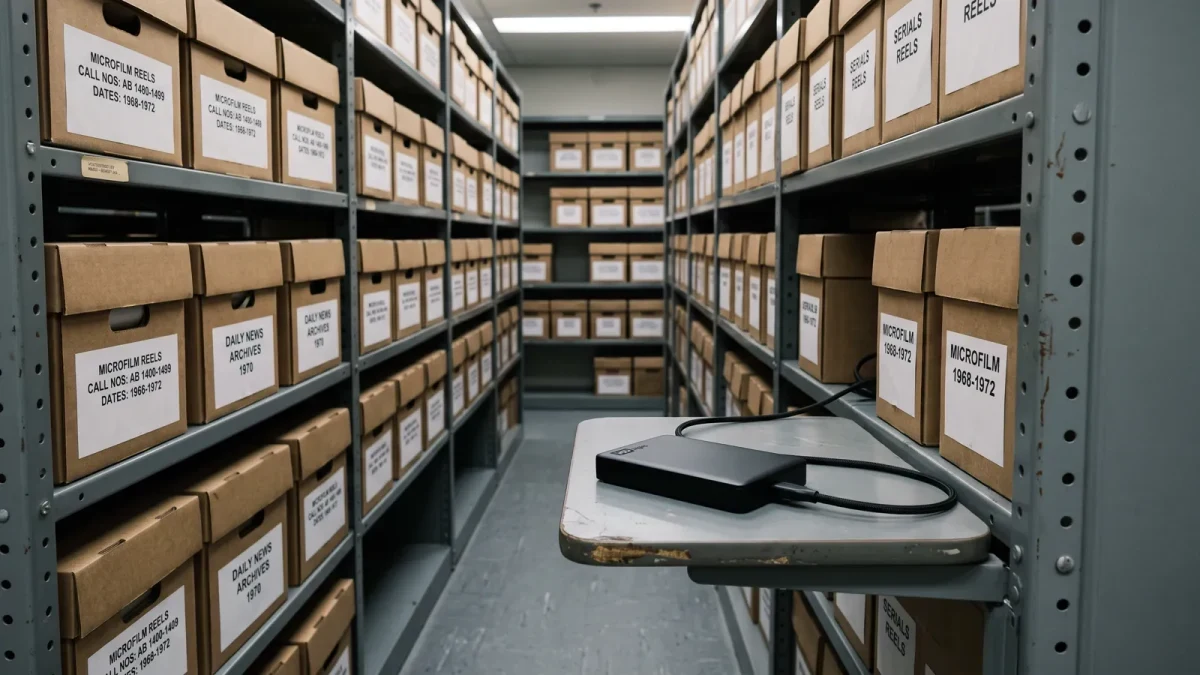
When a newsroom closes, its archive — the community's documented memory — survives only if someone planned for it, and digital archives die faster than paper ever did: a lapsed domain or an unpaid hosting bill can erase decades overnight. The rescues that work involve dedicated institutions: the Internet Archive's Wayback Machine preserves web pages at scale, state historical societies and university libraries hold microfilm and digital deposits, and the U.S. newspaper program's successor efforts have documented the nation's newspaper heritage for decades. For a newsroom still alive, the lesson of every failed outlet is that archiving is a current expense, not a closing task.
Why do digital archives fail?
Four quiet failure modes, each cheap to prevent and expensive to discover: domain expiration, which transfers the URL and breaks every incoming link; hosting cancellation, when a site on a vendor's server ends with the final invoice; format obsolescence, where exports exist but nothing can read them; and ownership ambiguity, where the archive's copyright status after dissolution is unclear enough that libraries hesitate to preserve it. Paper, whatever its costs, never needed an electricity bill to stay legible — the digital archive is immortal in theory and mortal in monthly payments.
What does a living newsroom do now?
A short list, cheap at any size:
- Deposit regularly. Annual exports — full text and images, in open formats — placed with a state historical society or university library under a written deposit agreement.
- Let the archivers in. The Internet Archive's crawling preserves public pages automatically; a newsroom can also submit its site and verify its crawl coverage — the service is free and the coverage check takes minutes.
- Own the formats. The CMS should export complete, standard content packages; test the export yearly by restoring one story with its images and metadata.
- Clarify the copyright. Incorporation documents and key contracts should say what happens to intellectual property on dissolution — the single clause that decides whether a library can legally save the archive later.
What happens in a rescue?
The documented rescues — a closed weekly's archive donated to a university, a shuttered daily's microfilm digitized by a historical society, communities crowdfunding the purchase of a lapsed archive from an owner in another state — share a sequence: the material physically located, the rights clarified, a repository found, and funding scraped together, usually small but always urgent because physical storage and decaying media add deadlines of their own. Newsroom trade associations and state press associations have run some of the most effective rescues precisely because they reach owners before the material scatters.
Who uses these archives, and why does it matter?
Genealogists first, then students, historians, lawyers, and reporters: the archive is where the anniversary story, the property dispute, the pattern of past decisions all come from. Communities that lose archives lose arguments — the factual record of what was promised, built, and covered up goes with the server. Journalistically, the local archive is also the training corpus for the community's understanding of itself; its loss is measurable the next time a controversy sends residents looking for what the paper once knew.
What should a closing newsroom's owner do?
Plan the archive before the final issue: inventory the holdings — print, microfilm, digital, photographic — and the rights; approach the state historical society and a university library with a deposit offer; and tell readers where the archive will live, in the final edition, so the community knows its memory has an address. Selling the archive to a private buyer is the option to weigh most carefully: it can fund severances, and it can also lock a community's record behind a paywall — both outcomes are the owner's to choose, and the choice is the last editorial decision the outlet makes.
Frequently asked questions
Isn't everything on the internet already saved somewhere?
No. Web archiving coverage is partial and lagging, paywalled content is largely uncrawled, and images and metadata often survive worse than text. The assumption of automatic preservation is the first myth every archive rescue corrects.
Can a small outlet afford digital preservation?
Deposit agreements with public institutions are typically free or cheap — the cost is staff time for the annual export. Preservation-as-a-service vendors exist for larger needs; most small outlets never need them.
Who owns the copyright after closure?
It passes with the business's assets — to buyers, creditors, or dissolvees — which is why the dissolution paperwork clause matters more than any technology.