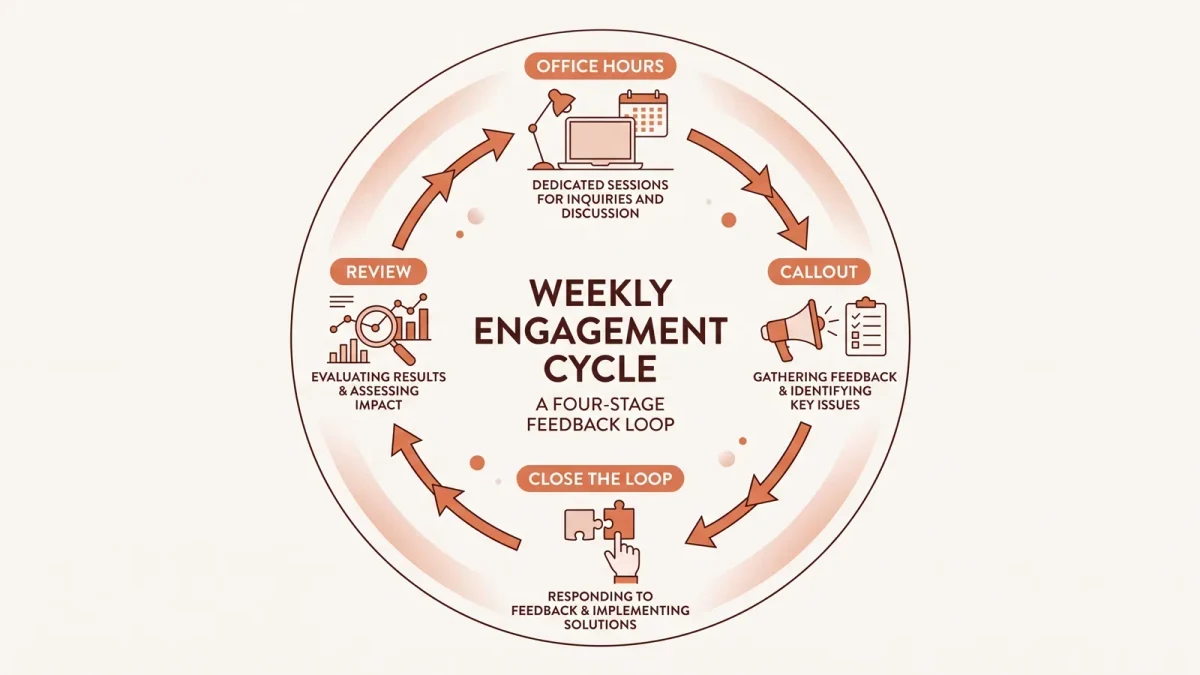
Engaged journalism asks for one structural change: listening appears on the reporter's calendar as work, not as what happens between work. The practice — developed across newsroom programs like Hearken's public-powered reporting model and the listening-post experiments documented by journalism research centers — shows consistent ingredients: scheduled community contact, callouts that ask real questions before stories are assigned, and closing the loop by telling people what happened with their input. Reporters who run it spend roughly a day a week on it, and the newsrooms that sustain it treat that day as a beat assignment, because it is one.
What does the week look like?
A workable rhythm for a reporter carrying a beat plus engagement duties:
| When | Activity | Output |
|---|---|---|
| Weekly | Office hours: a standing hour at the library or on the phone where anyone can bring a story | Tips, relationships, the questions residents actually ask |
| Per story | Callout before assignment: publish the question, collect answers for a week | Story angles grounded in community knowledge |
| After publication | Close the loop: tell contributors what their input changed; publish the follow-up question | Trust, and the next round of sources |
| Monthly | Review: which questions recurred, which neighborhoods answered, which did not | The engagement map — coverage gaps made visible |
Why does the loop matter more than the listening?
Because unclosed loops teach the audience that participation is extractive. The resident who answered a callout and never learned whether anyone read it does not answer the second one — and the field's published post-mortems keep finding that newsrooms abandon engagement not from budget cuts but from the quiet fizzle of unanswered contributors. Closing the loop is cheap: a group email, a line in the story crediting what the community added, a follow-up call to the three people whose input shaped it. It is also the single practice most correlated, in the case literature, with whether engagement survives its founding grant.
How is this different from social media replies?
Platform replies are reactive and public; engagement work is scheduled and often private — the church-basement conversation, the phone hour, the callout response read individually. The difference shows in who participates: public comment channels select for the confident and the aggrieved; direct outreach reaches the residents every newsroom says it wants and never hears from. The method's test is whether the source list grows more diverse each quarter, and that metric — unlike follower counts — cannot be gamed by volume.
What are the honest limits?
Three. Engagement is not coverage by plebiscite: the community's questions inform the agenda, the editor still sets it — and says so plainly, because pretending otherwise invites capture by whoever attends the most meetings. It is labor: the day a week is real, and a newsroom that assigns it without removing something will watch both halves of the job degrade together. And it is slow: the relationship dividends arrive in months, which is why the practice pairs naturally with patient funding — membership, grants with multi-year terms — and collapses under quarterly metrics.
What should a newsroom measure?
Participation that recurs: callout respondents who return, office-hour regulars, the number of stories whose origin is traceable to community input, and the diversity of the resulting source list against the community's actual makeup. Counting event attendance or reply volume measures marketing. The distinction is simple: engagement metrics count relationships; marketing metrics count impressions.
Frequently asked questions
Can a two-person newsroom afford a day a week of listening?
It cannot afford not to, in markets where the outlet's survival depends on community financial support — the listening day is where membership asks are grounded. Start with one office hour and one callout per week; scale when the tips start arriving.
Isn't this what reporters always did?
The habits, yes — town-beat reporters of the last century lived in the community. The innovation is scheduling it in an era when the workflow otherwise consumes the reporter at the desk.
How do you avoid the loudest voices taking over callouts?
Curate for representation, not volume: report the range of answers, weight the quiet neighborhoods' input explicitly, and vary the channels so each callout reaches beyond the previous respondents.