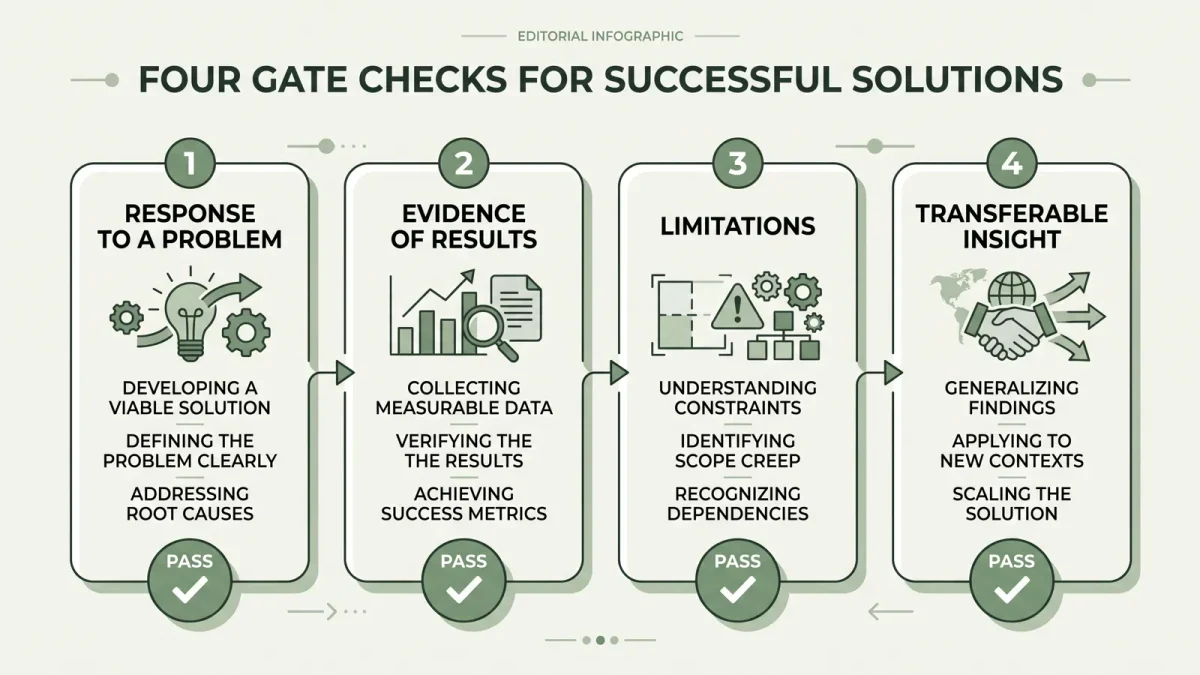
Solutions journalism — rigorous coverage of responses to social problems, with evidence of results and limitations — changes the assignment desk before it changes any story. The Solutions Journalism Network, which has trained newsrooms and built a story database since 2013, defines the practice by four tests: the response addresses a problem; evidence shows how it worked; it surfaces limitations honestly; and the story teaches something transferable. None of that softens standards; all of it changes the question from "what went wrong?" to "who is trying what, and is it working?"
What does the evidence requirement actually demand?
The same as any accountability story: documents, data, named sources, and a willingness to report that the response failed. A solutions story is not a profile of a well-meaning program; it is an investigation of an intervention's results. That means outcome data where it exists, candid interviews about what did not work, and comparison — what happened in the similar town that did not try this? The discipline protects the desk from the genre's real risk, which is not cynicism but public-relations capture: a program with a communications officer and no results can generate warm coverage precisely because the reporter asked what the program intends rather than what it measured.
How does the assignment sheet change?
In four practical ways:
- The standing question: every problem story gets a paired question at pitch stage — who else has faced this, and what did they try? The answer may be "nothing," which is itself reportable.
- The evidence hunt starts earlier: if a response exists, the data request goes in before the interviews, because the evidence sets the story's spine.
- Beat pairing: the education reporter who covers the failing school also owns the coverage of schools that turned similar numbers around — same beat, both directions.
- The limitations paragraph is structural: a solutions story without an honest account of what the response has not achieved fails the desk's standard, the same way an accountability story without the target's response fails.
What is the honest criticism of the practice?
Worth stating, because readers and editors raise it. Solutions framing can tilt toward optimism bias — the desk pitches responses because they are stories, and the aggregate picture can read rosier than the underlying conditions. The remedy is coverage balance at the desk level, not within each piece: solutions stories sit beside problem coverage in the same newsletter, and the outlet's overall mix answers the fairness question. The second criticism — that funders like the genre — is answered by the funder-disclosure rules that apply to all coverage: name the funding of the beat, and the genre question dissolves into the ordinary independence policy.
What does it do for audience and revenue?
Reported effects in the practice's published case studies: engagement depth (readers finish these stories and share them differently than problem coverage), and audience trust — some survey work associates exposure to solutions coverage with reduced news avoidance, a finding consistent with the broader research on why audiences disengage from purely negative news. For a local outlet, the practical benefit is simpler: the solutions question produces original stories no metro competitor has, because it requires knowing the community's actors rather than its incidents.
Where should a small desk start?
One story, chosen where the desk already has the problem side covered and the data exists: the county's opioid response, the school district's literacy program, the town's housing pilot. Assign it with the four tests printed on the brief, run the limitations paragraph past the editor explicitly, and debrief on whether the assignment sheet's standing question survives the deadline. If it does, the practice has taken — not as a philosophy, but as a Monday habit.
Frequently asked questions
Is solutions journalism the same as positive news?
No. Positive news selects for uplift; solutions journalism selects for evidence about responses, including evidence of failure. The genre's integrity lives in the limitations paragraph.
Does it excuse covering problems less?
In disciplined newsrooms it produces more problem coverage, because the response question leads back into the problem's mechanics. The either/or framing is the first misconception to retire at the desk.
How do you keep a solutions story from becoming an ad for the program?
The same safeguards as any story: independent data, voices beyond the program's participants, the comparison case, and an editor reading specifically for claims the evidence does not carry.