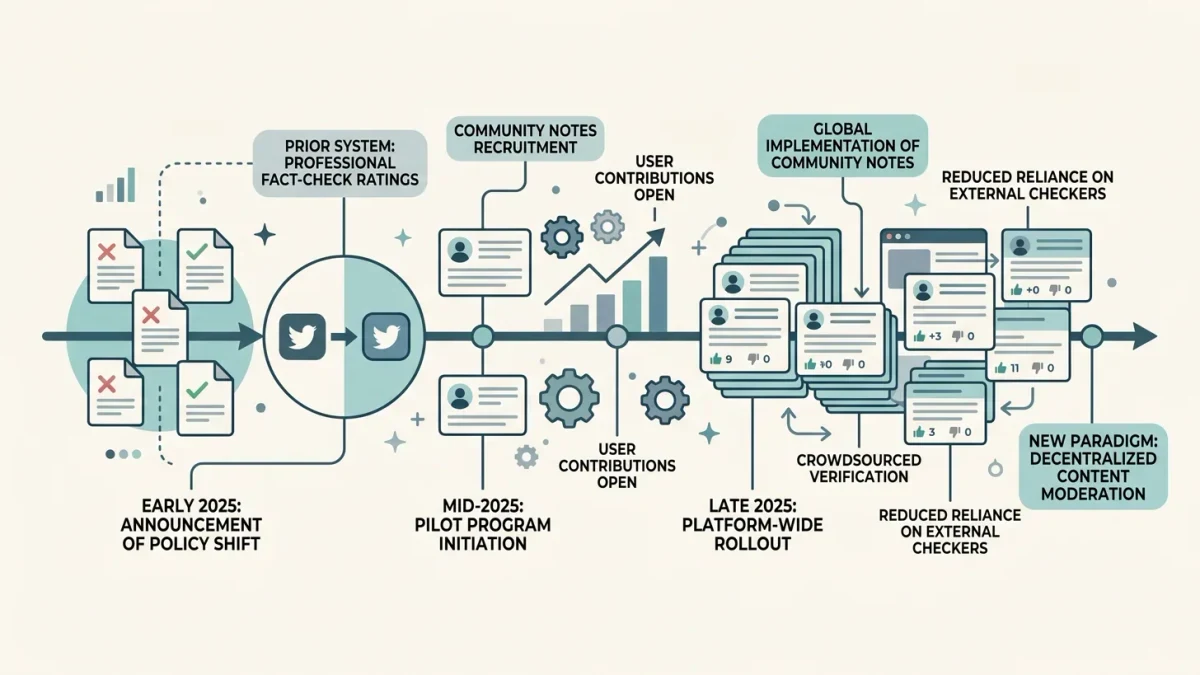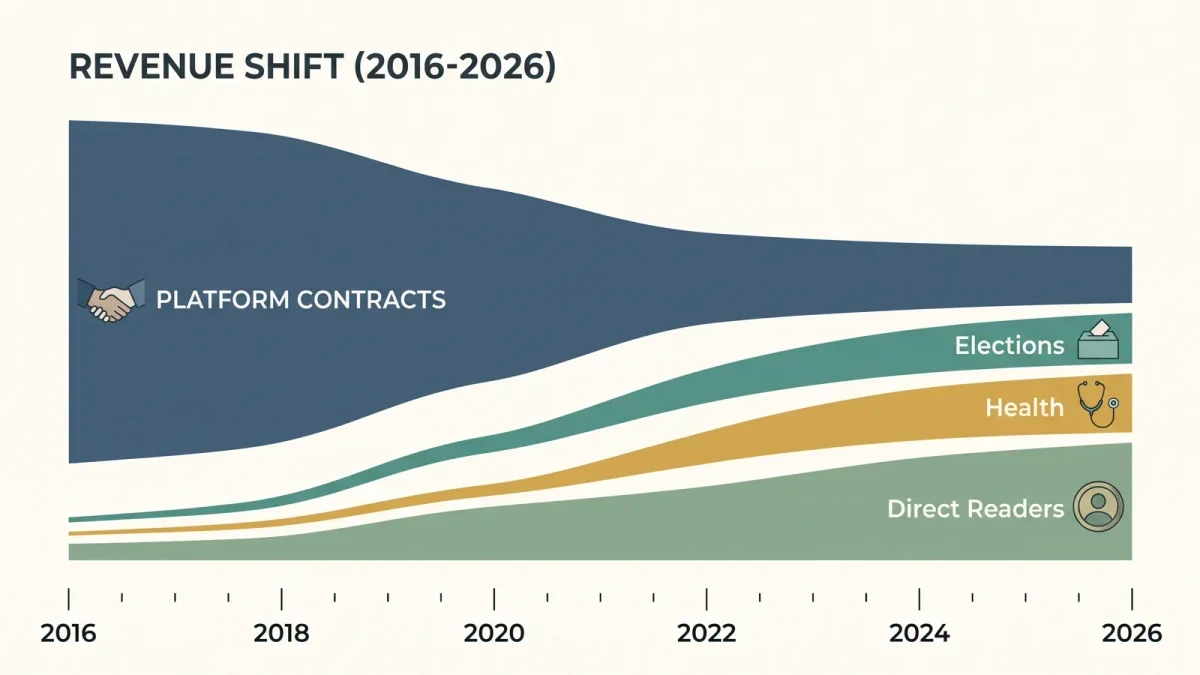
Independent fact-checking has spent the period since Meta ended its U.S. third-party fact-checking program — announced in January 2025 — rebuilding around audiences it owns. The platform partnerships that distributed check labels to billions of feeds are gone in the United States, and the field's response, visible across the fact-checking organizations verified under the International Fact-Checking Network's code, has been a deliberate pivot: elections and health as anchor beats, direct newsletters and media partnerships as distribution, and funding diversified away from any single platform. The Meta decision was the sector's sharpest single revenue and distribution shock since the field consolidated in the late 2010s.
What did the platform deals actually provide?
Two things, and only one of them was money. The payments were real — Meta's program, running since 2016, paid partner organizations in dozens of countries for checks used in its labeling systems. But the distribution mattered more: a check produced in a small newsroom could appear beside a viral post seen by millions. When the U.S. program ended and Meta moved to a community-notes model, U.S. partners lost both at once, and organizations in other markets began planning for the same outcome arriving there — Meta has since wound down the program in additional countries.
Where is the field going instead?
Three directions recur across the surviving organizations' published strategies:
- Anchor beats: elections and health, where demand is durable, funders are established, and the work ties to institutional partners — election authorities, public-health agencies — rather than platforms.
- Own distribution: newsletters, syndication to newsrooms, and radio and broadcast partnerships that put checks where readers already are, without an intermediary that can leave.
- Media-literacy and pre-bunking: teaching the manipulation technique rather than chasing each instance — work that scales with staff rather than with platform reach.
What can a local newsroom use from this?
More than before, actually. Fact-checking organizations freed from platform obligations increasingly welcome newsroom partnerships: syndicated checks, shared tiplines, and collaborative election projects that give a local outlet national-grade verification without national staff. The practical moves for a small newsroom: adopt the IFCN signatories' published output for claims circulating locally; build the relationship before election season, when demand peaks; and apply the same standards — evidence shown, sources named, correction policy published — in the outlet's own debunking items, where the credibility the field built is available to anyone who follows its method.
Does community moderation replace professional checking?
As distribution, partially; as method, no. Published analyses of community-notes systems — and the research community that studies them — converge on real strengths (credibility across divided audiences, scale) and real limits (slow consensus on contested claims, uneven coverage of non-English content, gaming pressure). Professional checking's distinct contribution remains the accountable byline and the shown evidence. The two are complements, which is why most fact-checkers now describe their role in an ecosystem rather than as a label attached to posts.
What is the honest outlook?
Smaller, more durable, more local. The field that grew on platform contracts is settling into the shape of public-service journalism generally: harder money, owned audiences, and deep cooperation among small organizations. Fact-checking's core asset — a method readers can watch working — survived the platform decade intact, and every newsroom that publishes its evidence practices the same craft at its own scale.
Frequently asked questions
Are fact-checkers politically neutral?
IFCN-verified organizations commit to non-partisanship and transparency in a audited code; the verification is the checkable answer, and the signatories' methodology pages let any reader test the claim rather than trust the label.
Can a small outlet label itself a fact-checker?
It can do the work by the method — evidence shown, sources named, corrections published — and say so. Formal IFCN verification is a program with process requirements designed for organizations, not a license to practice.
What happened to Meta's program outside the U.S.?
It has been wound down in additional markets since the 2025 U.S. decision, on a timeline Meta has announced in stages — which is why partners worldwide planned for the same pivot rather than waiting.