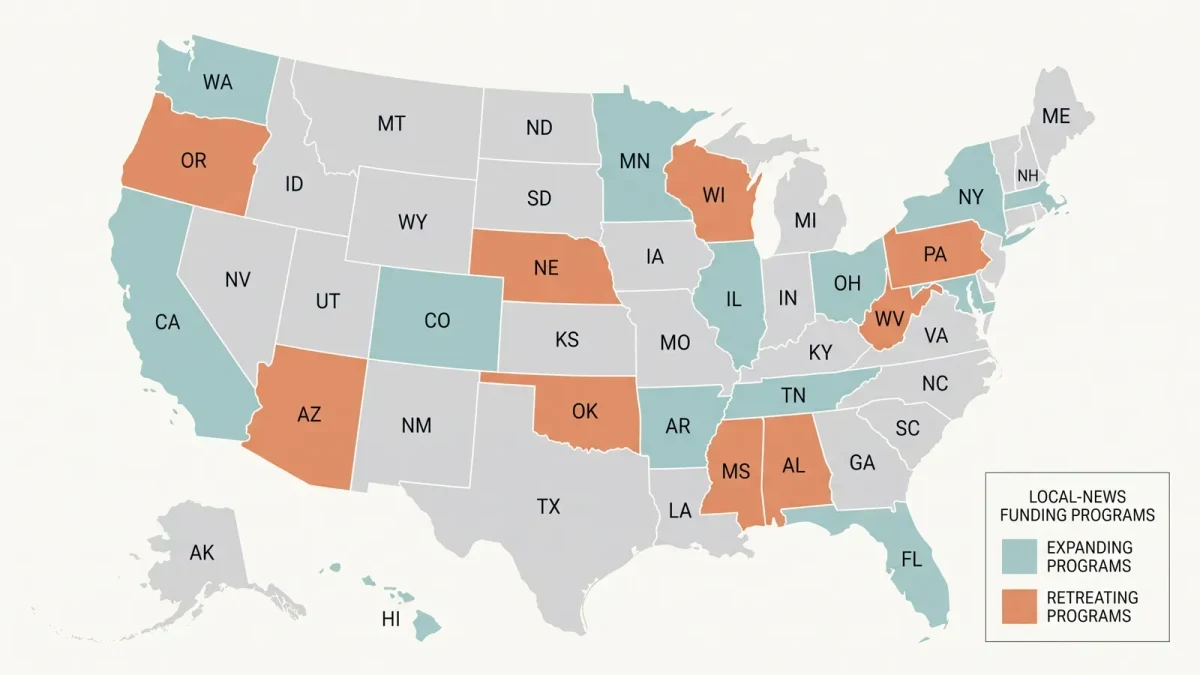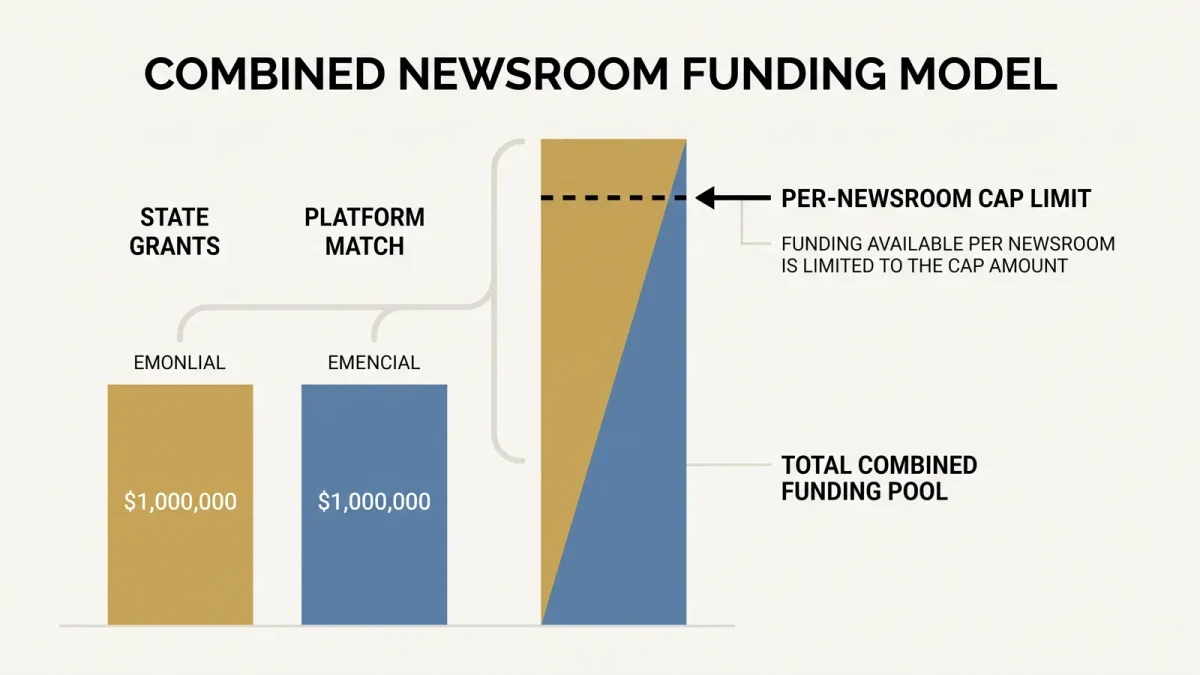
California Governor Gavin Newsom announced 20 million dollars in state grant funding for local journalism on July 14, 2026, matched by Google, with eligible newsrooms able to apply for up to 250,000 dollars each, per the governor's official announcement. The program extends California's experiment — begun with its earlier News Partnership negotiated with Google — in funding local news through a public-private structure rather than a conventional subsidy, and it lands into a national moment in which state support for local journalism is estimated at about 74 million dollars for 2026, per a Poynter analysis published the same year.
What is in the program?
Per the announcement: 20 million dollars in state grants for eligible California newsrooms, with a per-newsroom ceiling of 250,000 dollars, and Google matching the state's contribution. The design follows the vocabulary of the state's earlier partnership arrangement — public money paired with platform money, distributed through a grant process rather than paid as an entitlement — and joins the state's existing local-news measures, which have included fellowship placements and public-university journalism programs. Application details and eligibility criteria are administered through the program's published channels at ca.gov, and newsrooms should read the criteria — staffing, publishing, and independence conditions are typical of the genre — before counting the money in any budget.
What does the match actually mean?
Two things, one fiscal and one political. Fiscally, the match doubles the pool without doubling the state's outlay — the same structure California pioneered in its earlier deal, in which Google committed public-interest funding alongside state programs. Politically, it keeps a platform at the funding table, which is the feature and the controversy in one: supporters argue platform money owed to the news ecosystem should flow through transparent public channels rather than private deals; critics, including outlets and legislators who preferred a harder bargaining-code approach, argue that negotiated philanthropy is cheaper for the platform than a legislated obligation, and that a voluntary match today can be a precedent against mandatory contribution tomorrow.
What should a California newsroom do now?
- Read the eligibility rules at the official program page before applying — frequency, staffing, and California-operation requirements are the usual gates.
- Price the compliance exactly as any grant: reporting hours, match documentation, and the administrative share written into the application budget.
- Disclose on acceptance: the transparency page lists the funder and amount, and coverage touching Google or the state program notes it — the standard independence discipline for any funded beat.
- Cover the program as journalism: who received grants, who was refused, how the match is disbursed and audited — the accountability coverage that every public-funding scheme needs and that only a free press provides.
Why does this matter outside California?
Because California is the largest laboratory for the platform-match model, and its results will be cited in every statehouse considering journalism funding — the same dynamic by which the state's vehicle and platform rules tend to become national templates. The open questions the program will answer over its term: whether the match materializes at the promised scale, whether small and community outlets win grants proportionate to their share of the state's news needs, and whether the arm's-length administration holds when a funded outlet investigates the governor's office. On those three answers, the model either travels or stops at the border.
Frequently asked questions
Who can apply?
Eligibility is defined in the program's official criteria — typically California-operating news organizations meeting publishing and staffing tests; the ca.gov program page is the authoritative source.
Does taking the grant restrict coverage of Google or the state?
Not under any defensible terms — but disclosure and continued independent coverage of both funders is the practice that makes the terms real. Newsrooms should publish their grant and then cover the program like any other state expenditure.
How does this relate to earlier California-Google arrangements?
It extends the partnership approach: earlier commitments funded fellowships and programs; the July 2026 announcement adds direct newsroom grants with the match. The bargaining-code alternative remains unpassed, which is the political context of both.