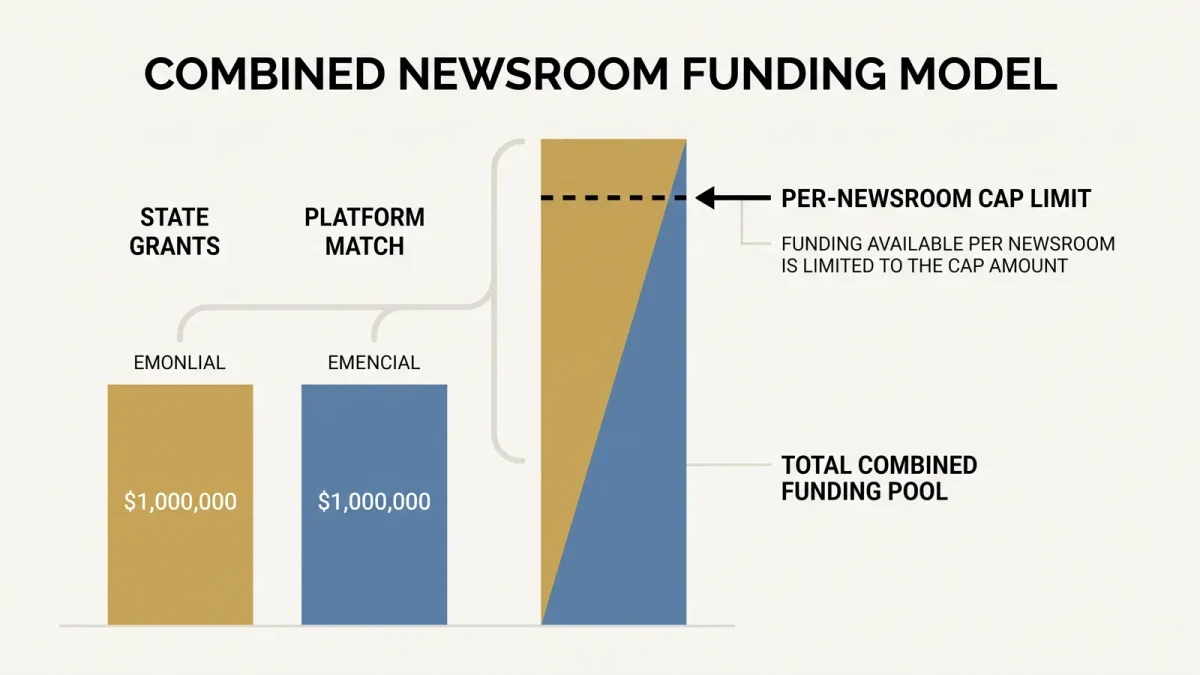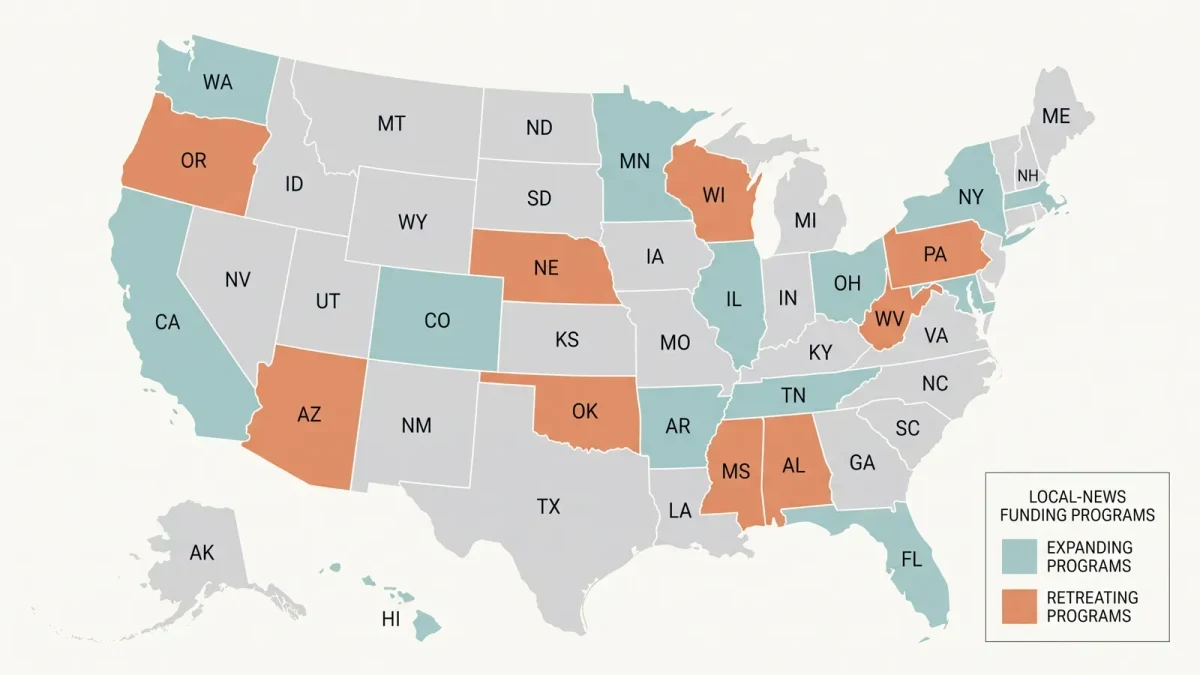
Public money is entering local journalism through a widening set of doors: Australia's News Media Assistance Program pays per eligible journalist employed from 2025–26; a range of U.S. states now run tax credits and grant programs for local newsrooms, worth an estimated 74 million dollars in 2026 per a Poynter analysis; Canada has renewed its local journalism measures; and the UK's 2026 Amplify plan funds training and community coverage. The design question every scheme must answer is the same: what stops the money from becoming leverage? The answers that work are structural — arm's-length administration, transparent criteria, and legal insulation — and the newsroom's job is to demand them in print before accepting a cent.
What does arm's-length actually mean?
Three separations, visible in the best-run schemes. Administrative: decisions route through an independent body — a commission, a foundation, a statistical agency — rather than a ministry's discretionary budget line. Criterial: eligibility is formula-based (journalists employed, content published, notices run) so that no official's judgment about a newsroom's coverage affects the payment. Legal: the statute says, explicitly, that funding creates no right of review, direction, or preference. Schemes missing any leg tend to fail the sniff test the first time a funded outlet investigates the government that funds it.
What can go wrong?
The documented pathologies recur across countries. Quiet pressure: no explicit demand, but editors feel the renewal cycle every time an investigative story runs — which is why multi-year, automatic renewals matter more than amounts. Capture by incumbents: criteria designed for legacy outlets exclude the new digital and community newsrooms the funding was ostensibly for. And the chilling audit: tax-credit schemes administered through partisan tax authorities invite harassment complaints against disfavored outlets. None of these requires a villain — each emerges from ordinary administrative friction unless the design pre-blocks it.
What should a newsroom do before taking public money?
- Read the terms for editorial strings — and publish them, whatever they say. Disclosure is the cheapest independence protection.
- Adopt or reaffirm an independence policy: no advance review, no coverage promises, and a stated response if any official attempts influence — publish the attempt.
- Disclose the funding in coverage contexts: a standing disclosure on the site, and where the money funds a beat, on that beat's stories.
- Decide the refusal line in advance: some outlets decline government funding entirely on independence grounds; that is a defensible position, and the decision belongs to the outlet's ownership, made deliberately.
Does public funding work at all?
The honest ledger: yes, with design. The democratic world's public broadcasters — licence-fee and levy-funded for decades — are the standing demonstration that state-funded news can out-perform private media on trust when governance holds; the Nordic countries' subsidy schemes have run for half a century with arm's-length administration intact. The failures are equally documented, and they fail on governance, not on the money. For local news specifically, the newer schemes are young enough that their results are the story journalists should be covering — which is itself the test: a healthy scheme can fund the outlet investigating it.
Who watches the funders?
The funded press, and that is not a paradox but the design's completion. A public-funding program for journalism that cannot survive hostile coverage of itself was never arm's-length, and discovering that early — in print, with documents — is the sector protecting both its income and its reason for existing. Newsrooms that treat the funding debate as an accountability beat rather than a revenue announcement are doing the work the scheme's designers should hope for.
Frequently asked questions
Is accepting public money compatible with criticizing the government?
With structural insulation, yes — decades of public-service media demonstrate it. Without insulation, the risk is not the criticism but the editor's self-censorship before it.
Should tiny outlets take small public grants?
If the terms are clean and the disclosure is complete, yes — and the outlet should price the compliance burden exactly as it would a private grant's.
What is the single strongest protection?
Automatic, formula-based renewals that no official can touch case by case. Everything else is secondary to removing discretion.