U.S. state governments are expected to direct about 74 million dollars to local journalism in 2026, per a Poynter analysis published in 2026, with the money moving through tax credits, grant programs, fee waivers, and public-notice reforms rather than any single national scheme. The same analysis documented the pattern's texture: expansion in some states, repeal fights in others, and a policy field that has grown from a curiosity in 2018 — when Illinois ran its first newspaper tax credit — into a standing category of state media policy.
What are the mechanisms?
Three dominate. Employment tax credits on the Illinois model, later adopted by New York in a much larger form — credits against state taxes for employing local journalists, which effectively subsidizes the reporting wage. Grant and voucher programs — state-funded grants for local news operations, civic-info consortia modeled on New Jersey's Civic Information Consortium, and public-notice money redirected through voucher systems. And procurement and notice reforms — requiring or preserving publication of public notices in qualified local outlets, which functions as recurring revenue without a budget line. States have also waived fees and offered advertising spend as quieter instruments.
Where is it expanding, and where is it retreating?
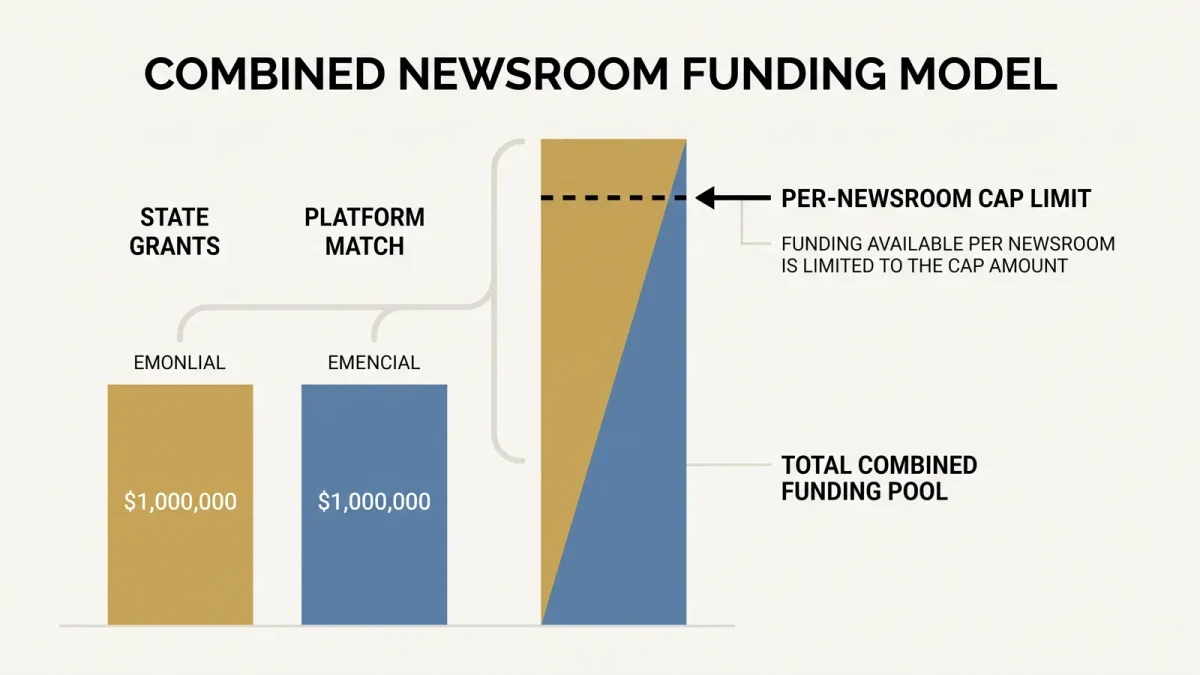
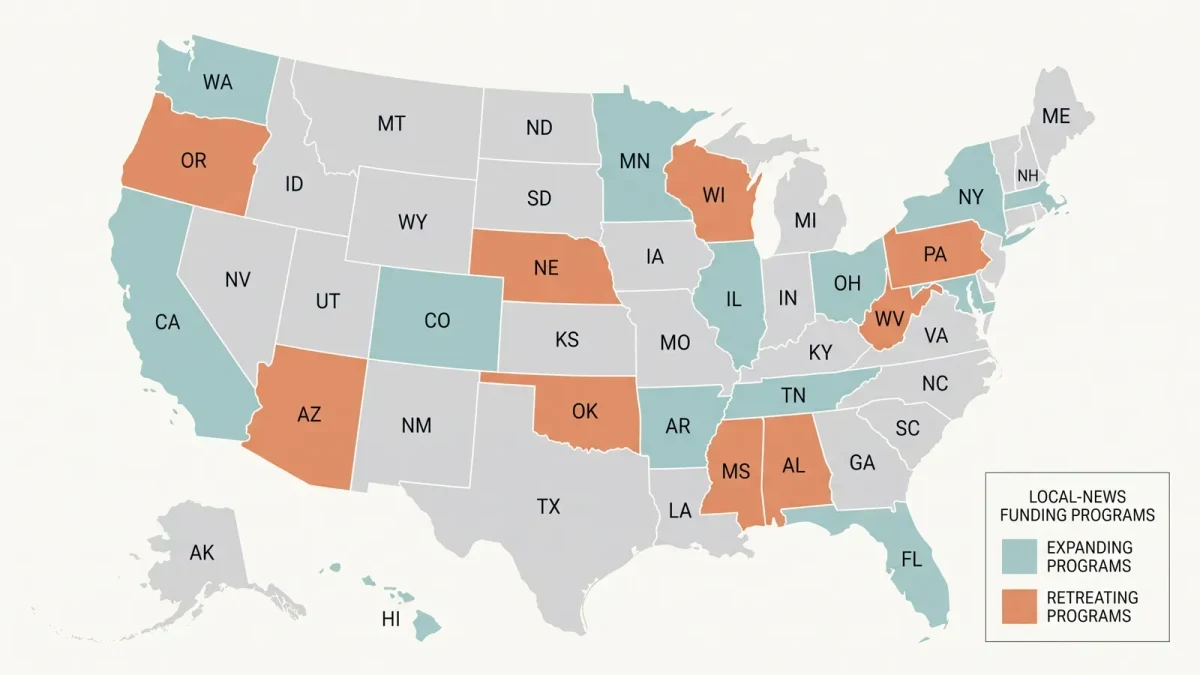
The Poynter analysis and statehouse reporting through 2025–26 show a map that does not follow partisan lines cleanly: several states have enacted or expanded credits and consortia, while others have seen programs challenged or allowed to sunset, and California built its own negotiated arrangement with platform money alongside state funds — the July 2026 announcement of 20 million dollars in state grants matched by Google for local newsrooms continues that track. The consistent detail across states: programs that survive are the ones with arm's-length administration and formula-based eligibility, and programs that die tend to die in appropriation fights, not independence scandals.
What should a local publisher actually do with this?
Treat state policy as a beat the outlet covers and may also be eligible under — in that order. Practically: track the state press association's legislative alerts, which monitor every bill affecting notices and credits; read the eligibility rules before counting the money in any budget, since frequency and staffing tests commonly apply; and if the outlet participates, disclose it on the transparency page with the same discipline applied to philanthropic funders. The public-money independence rules are the same as any funder's: disclose, insulate, and cover the administering agency as journalism.
What are the risks practitioners cite?
Three, from the published debate. Dependence: a credit that becomes a structural part of small-outlet budgets makes every statehouse election a revenue event. Capture optics: outlets taking state money while covering the statehouse face the perception question regardless of legal insulation — answered, again, by disclosure and visible coverage. And displacement: subsidies that flow to incumbents while digital startups get nothing can slow the market's adaptation — the reason newer designs, including per-journalist formulas, try to be platform-neutral.
Is national public funding coming?
The U.S. federal government has not adopted a broad local-journalism subsidy, and the political coalition for one does not exist; the action is state-level and likely to remain so. That makes the state programs the live experiment — and their results, published independently by the newsrooms they fund, are the evidence base the next decade of policy will argue from. Journalism's own coverage of these programs is not a side interest; it is the audit the legislatures did not fund.
Frequently asked questions
Does taking a state tax credit compromise coverage of state government?
The risk is perceptual rather than mechanical, and it is managed the way any funding risk is: disclosure, an independence policy, and demonstrated coverage of the program itself. Outlets that cover their own subsidy honestly report no chilling in practice.
Are nonprofits and for-profits eligible equally?
Mechanism by mechanism: tax credits reach taxable for-profits; grants and consortia are often nonprofit-weighted; notice reforms reach any qualifying publication. Publishers usually combine more than one.
Where does the $74 million figure come from?
Poynter's 2026 analysis of state programs — an estimate across mechanisms, published with its methodology, and the figure to cite with attribution and year when writing about it.