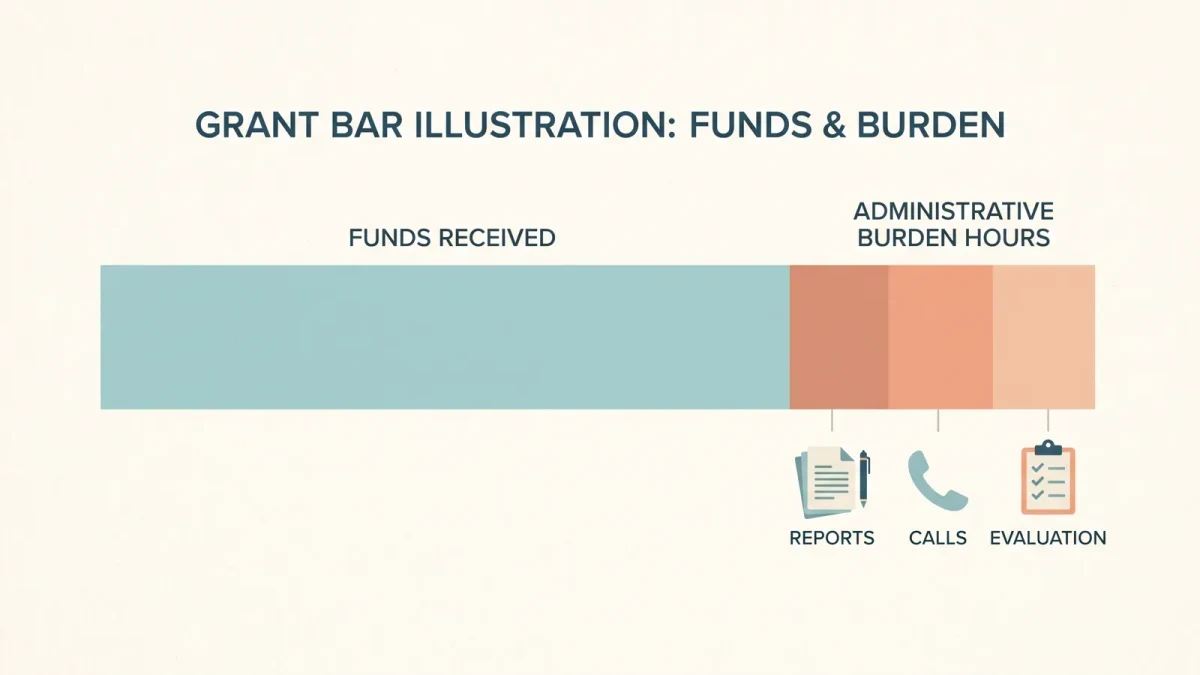
Every grant a small newsroom accepts carries a second price: the reporting burden. Final reports, mid-grant calls, evaluation frameworks, outcome metrics, and financial reconciliations consume staff hours that appear on no invoice — and the Institute for Nonprofit News, whose annual index surveys the nonprofit news field, has documented both the field's growing grant dependence and the operational strain that accompanies it. The newsrooms that thrive on grants are the ones that price the burden before accepting the money.
What does the second budget contain?
Three line items, each estimable in advance:
- Compliance hours: the written reports and financial reconciliation the agreement requires — often a week of combined staff time per grant year at a small outlet.
- Relationship hours: program-officer calls, site visits, convenings. Real and sometimes genuinely valuable — but hours all the same.
- Evaluation hours: outcome measurement the funder requires, which in a newsroom usually means analytics work nobody was staffed to do.
The working heuristic experienced grant managers use: estimate the burden at fifteen to twenty-five percent of the grant's value for small awards, declining as grants grow larger. A $10,000 grant that consumes $3,000 of staff time is a $7,000 grant with extra meetings.
How do you price it honestly?
Track hours on one grant cycle — a simple timesheet category is enough — and compare the total against the award. The result is usually the most persuasive internal document a newsroom can produce, because it converts a vague sense of exhaustion into a rate per grant dollar. From there, two policies follow naturally: include administrative cost in every project budget the newsroom proposes — funders increasingly expect it — and set a floor below which unrestricted small asks are declined politely, because the hours exceed the money.
What terms are negotiable that small newsrooms assume are fixed?
More than expected, and funders themselves say so in published grantmaking-practice commitments. Report formats can often be simplified to a letter; reporting cadence can shift to match the work's rhythm rather than the fiscal year; evaluation can use metrics the newsroom already collects. The ask that most improves small-outlet life is payment timing — installments front-loaded enough that the newsroom is not financing the funder's program. None of these asks is unusual; the unusual part is a grantee making them, which requires knowing the burden's real number.
When should a newsroom decline money?
When the grant's purpose bends coverage — funding tied to a beat the newsroom cannot staff honestly, or to outputs its editors would not choose independently. Editorial independence policies exist for exactly this decision, and the moment to apply one is before the award, when declining is still possible. The other decline-worthy case is arithmetic: a small short-term award whose burden consumes its value plus margin. Saying no cleanly, once, preserves the relationship for a better-designed ask later.
What does a healthy grant portfolio look like?
Concentrated enough to manage, diversified enough to survive: a few multi-year commitments covering core operations, a couple of project grants aligned with the newsroom's own editorial plan, and no grant whose loss would close a beat overnight. Grant dependence is the field's shared condition; grant fragility is a portfolio choice. The newsrooms that treat the second budget as seriously as the first are the ones whose funding survives a funder's strategy change.
Frequently asked questions
Should administrative overhead be written into project budgets?
Yes — funders committed to better grantmaking practice expect it, and omitting it silently donates the newsroom's operating capacity to the funder.
How many grants can a two-person newsroom carry?
Rarely more than two or three active at once once reporting overlaps. The constraint is calendar, not cash: three reporting deadlines in one month will eat a month of journalism.
Are program-officer relationships worth the hours?
Usually yes — they carry renewal intelligence and honest feedback. The discipline is counting them in the second budget rather than pretending they are free.