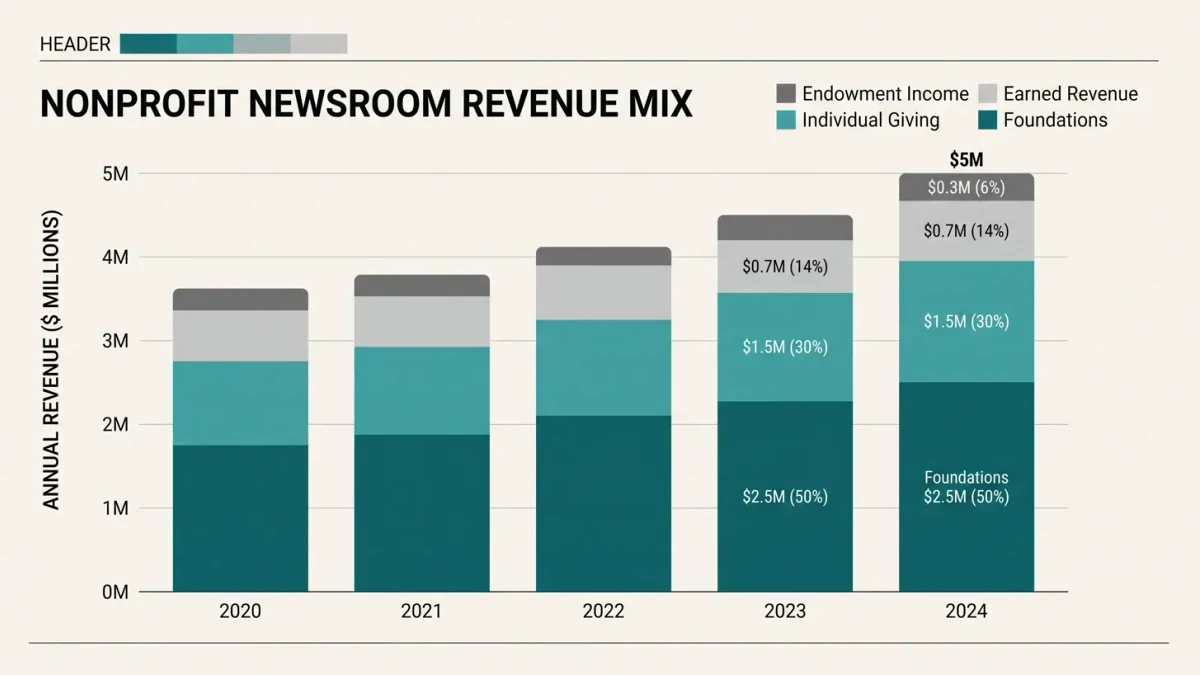
Philanthropy is the majority revenue source for nonprofit news in the United States: the Institute for Nonprofit News's annual index has reported for years that foundation and major-donor giving accounts for the largest share of member revenue — roughly half or more across the sector in recent editions, with earned and individual income making up the rest. The same index documents the concentration risk: a small number of large national funders account for a disproportionate share of the total, and newsrooms' own reports show how often a single grant covers a named beat. Concentration is the model's structural weakness; disclosure is its structural defense.
Why does concentration matter?
Because a funder's strategy change behaves like a market crash. When a large foundation reshuffles priorities — as the Knight Foundation's evolution away from direct local-news grantmaking demonstrated in the 2010s — entire programs across many newsrooms lose funding in the same quarter. Outlets diversified across dozens of smaller donors, individual members, and earned revenue absorbed the shock; outlets built on two anchor grants did not. The field's own analysts have repeated the finding: diversity of sources predicts survival better than size of budget.
What does honest disclosure look like?
The standard set by the sector's own transparency practice, and required in substance of INN members, has three layers:
- A funders page, updated at least annually, listing every funder above a stated threshold — five percent of revenue is a common line.
- Story-level funding disclosure: when a beat or series is grant-funded, the funder is named in the coverage's own funding box, and in every piece it carries.
- An independence policy: funders receive no advance review, no editorial input, no veto — stated publicly, with the newsroom's enforcement path visible.
Disclosure is not an apology; it is the same practice the sector asks of every institution it covers. A newsroom that discloses its funders while covering a city hall that conceals its vendors occupies the stronger position in that argument.
Does philanthropy buy influence?
The honest answer is: it buys proximity, which is why the rules exist. Published examinations of funder influence in nonprofit news — academic studies and the sector's own self-criticism alike — find little evidence of direct editorial interference, and meaningful evidence of subtler pressure: self-censorship on topics a funder cares about, beat creation that follows money rather than community need, and the quiet drift of coverage toward fundable themes. The defenses are governance: an independence policy with teeth, an editor whose contract names final editorial authority, and a board that includes voices independent of the funding community.
What should a small newsroom do practically?
Four habits, cheap at any size. Disclose every funder over the threshold, in plain language, on one page. Never accept funding whose terms touch coverage — and put the refusal policy in writing so declining is institutional, not personal. Watch the concentration ratio: no single funder above a self-imposed share of revenue — many outlets use something like a quarter to a third — and fundraise against the ceiling deliberately. And cover the beat a grant funds as though it were permanent, because journalism that only exists inside a grant period reads, to readers, as temporary.
Is the philanthropic model itself sustainable?
Sustainable with limits, is the field's emerging answer. The sector's total philanthropic take remains small against the scale of local-news need — estimates of the local journalism funding gap run to billions annually — and the growth of press-freedom and local-news funder collaboratives in the 2020s shows funders treating it as a long-term field, not a phase. The durable version of the model is the mixed one: philanthropy for public-service coverage the market will not pay for, reader revenue for the daily relationship, earned income for the margin. Philanthropy as one leg, never as the ground.
Frequently asked questions
Should grant-funded coverage be labeled on every story?
Yes — the reader of a single piece deserves the same information as the reader of the archive. A funding box of one sentence carries it without ceremony.
Do funders ever see coverage before publication?
Not under any defensible policy. Recognition copies arrive after publication, like any reader's. The independence policy should say so explicitly.
Can a newsroom survive losing its largest funder?
With preparation, yes: a reserve of some months' operations, a diversification plan already running, and a board informed of the concentration risk. Without preparation, the beat closes and the reporter leaves — which is why the ratio cap exists.