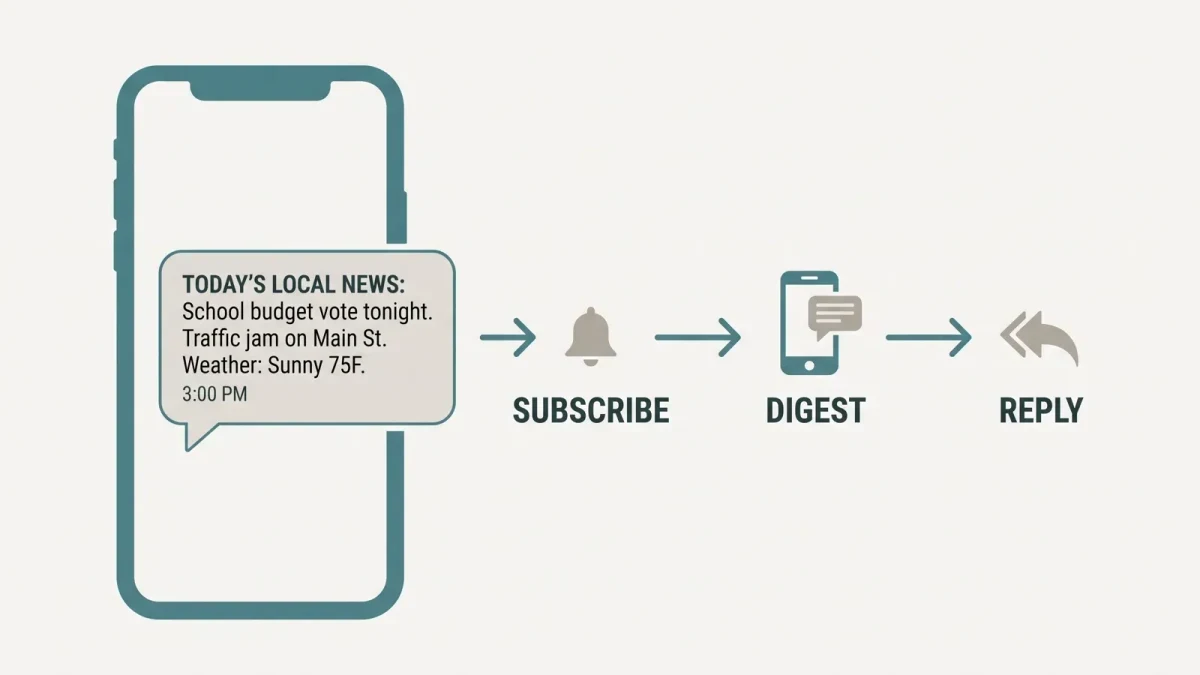
Text-message news works because it arrives on the default screen. No app download, no notification permission, no feed algorithm decides whether a reader sees the message — the open rates reported by newsroom text services routinely exceed email newsletters, and email newsletters already outperform social distribution. For a small newsroom, a texting list of a few thousand reachable residents is operationally worth more than social followings many times larger, because the channel cannot be throttled by a platform.
What made apps fail and texts succeed?
Local news apps asked the audience for a behavior — download, allow notifications, open a branded icon — that most readers never adopted for any single local brand. Texting asks for a phone number and then behaves like the messages readers already exchange daily. The power asymmetry also reverses: when a platform changes its algorithm, a newsroom's reach collapses overnight, but a phone number the newsroom collected is portable infrastructure. The trade is honest — the newsroom gets a channel that cannot be demonetized by a policy change, and the reader gets a message that can be silenced with one reply.
What belongs in a newsroom texting program?
The format discipline is stricter than email, because tolerance for unwanted texts is near zero. Three working patterns have emerged across local outlets:
- The daily digest: one message a day, a set hour, three to five sentences — what happened, what it means, one link.
- The alert service: silence except for genuine urgency — boil-water notices, evacuation updates, school closures. Trust depends on never spending the reader's attention on promotion.
- The two-way service: the number is published as a tipline; reporters answer questions and source stories from the replies. This is the hardest to run and the most valuable.
What are the real costs and risks?
Costs scale per subscriber: messaging fees apply to every send, so an inflated list of silent numbers is pure expense, and pruning is a virtue. The legal side has teeth — commercial messaging rules under laws like the U.S. Telephone Consumer Protection Act require clear opt-in and honor opt-outs immediately, and violations carry statutory damages. Editorial risk is subtler: a text feels personal, and a message that reads like a press release feels like a betrayal of that intimacy. Write in the register of a useful neighbor, not a headline writer.
How does a newsroom start without a vendor budget?
Start with one service and one promise. The smallest viable program is a single weekly civic digest — the meetings, deadlines, and closures of the week ahead — promoted with the phone number printed in every story footer. A two-person newsroom can run a weekly text with a spreadsheet and a low-cost messaging service; the discipline it teaches (writing short, sending on schedule, respecting silence) is exactly the discipline the daily version needs. Expand cadence only when the audience asks.
What does success look like?
Not follower counts. The metrics that matter are reply rate — the share of recipients who have ever texted back — and unsubscribe rate held near zero. A list where readers answer questions is a reporting asset, not just a distribution channel; several local outlets now source story tips through text faster than through any form on their site. The channel that replaced the app turns out to be the oldest one: a conversation.
Frequently asked questions
How often is too often to text?
For a digest, daily at a fixed hour is acceptable if the content is genuinely useful. For anything promotional, never. One off-mission message costs more unsubscribes than a month of good ones earns.
Should the number be a reporter's real phone?
A dedicated number through a messaging service protects the reporter's privacy and survives staff turnover. The byline can still be personal — sign the texts with a name.
Do older readers use text news?
Yes, and often first. SMS adoption crosses age groups in a way app adoption never did, which makes the channel unusually good for reaching residents that digital-first strategies miss.