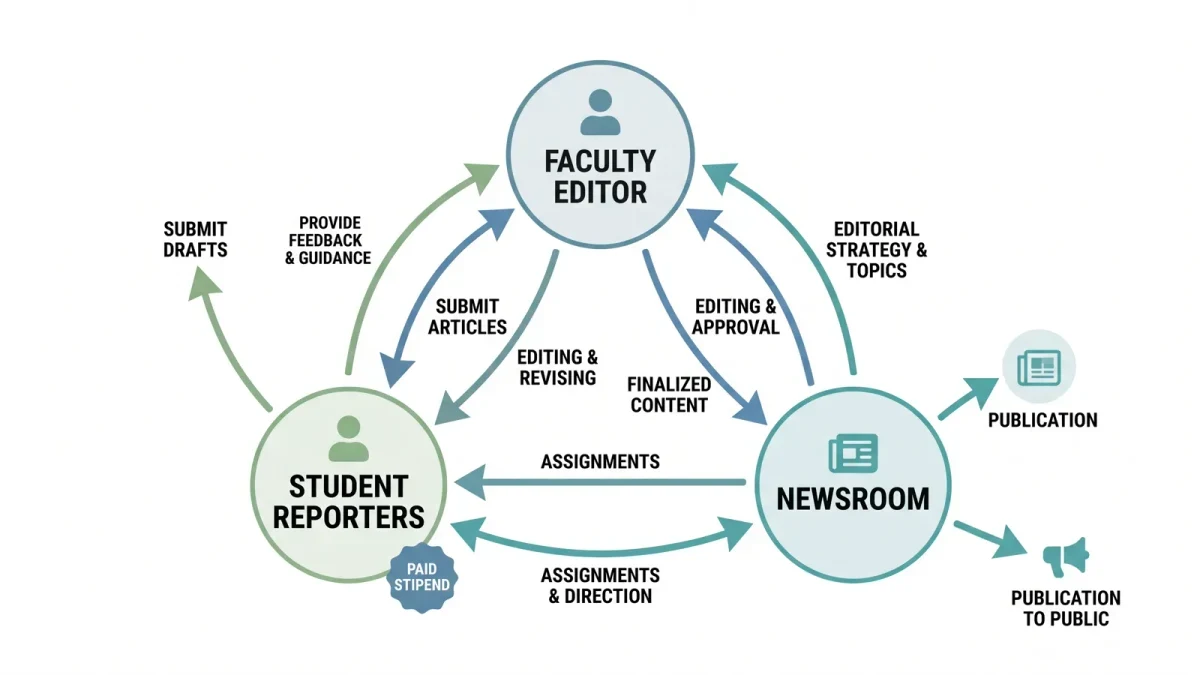
The student-journalist partnerships that work are paid, credited, professionally edited, and documented in a written agreement — and the ones that fail are unpaid content arrangements wearing the word mentorship. The model is proven: statehouse reporting programs staffed by students, university-led bureaus serving state media, and the professional-school newsrooms embedded in journalism programs have produced publishable accountability work for years. What separates the durable versions is that everyone's interests were written down first.
What belongs in the partnership agreement?
Six clauses, negotiated before any assignment:
- Compensation: stipends, course credit with defined hours, or wages — and the publication rights purchased accordingly. Unpaid labor publishing in a commercial outlet is the arrangement the field has spent a decade apologizing for.
- Editing standard: student work is edited to the outlet's professional standard by named editors, with the same verification checklist as staff work.
- Credit and bylines: real names, real roles; the outlet never presents student work as staff work.
- Liability and review: the outlet's counsel and the university's administration aligned on who defends what — student press freedom cases and outlet libel exposure are different animals, and both sides should know the plan.
- Editorial independence: the university does not review coverage of the university — the conflict every such partnership eventually faces, decided in advance.
- Duration and evaluation: a term, a review, and an honest kill-switch either side can pull.
What can student journalists actually deliver?
More than clipping: the documented successes include legislative coverage, open-records projects that aggregate hundreds of requests, FOIA-driven accountability series, and consistent coverage of bodies professional reporters stopped attending — city councils in small towns, school boards, planning commissions. Students supervised by faculty editors and outlet editors have won professional awards for such work. The honest constraint is rhythm: semesters end, cohorts turn over, and the partnership's editorial spine must live in the professional newsroom, not in any student cohort.
What does each side owe the other?
The newsroom owes training and seriousness: orientation on standards, the verification checklist, feedback on drafts rather than silent rewrites, and a reference at the end that means something. The students owe the work's professionalism: deadlines, corrections humility, and the understanding that the outlet's reputation is the asset both parties are spending. The university owes the structure: a faculty editor with real authority, alignment of academic incentives with publishing realities, and defense of student journalists when their coverage displeases powerful actors — including the university's own donors.
What are the failure modes?
Three recur. The content mill: an outlet treating the partnership as free copy, publishing thin work under professional branding, and poisoning the local reputation both sides need. The orphaned beat: coverage that dies every May when the semester ends, teaching readers not to rely on it. And the ghost edit: faculty rewriting student work until the byline is fiction — a teaching failure and an attribution problem in one.
How does a small outlet start one?
With a scope sized to supervision: one beat, two students, one faculty contact, one professional editor owner — a paid summer covering the summer's meetings is the classic pilot, because summer is when professional staffing is thinnest and the value is most visible. Publish the partnership's terms on the outlet's transparency page; the disclosure reads as seriousness to readers and as protection to the university.
Frequently asked questions
Do FERPA or student-privacy rules complicate the work?
They can in education-source stories; the faculty editor is the guide through what records and interviews are usable. The partnership should treat this as curriculum, not obstacle.
Who corrects a student's error after the semester ends?
The outlet — corrections are the publisher's duty regardless of authorship. The agreement should say so explicitly.
Is course credit legitimate compensation?
For work at professional standard, credit plus stipend is the defensible norm; credit alone, at a for-profit outlet, is the arrangement the field's own ethics increasingly reject.