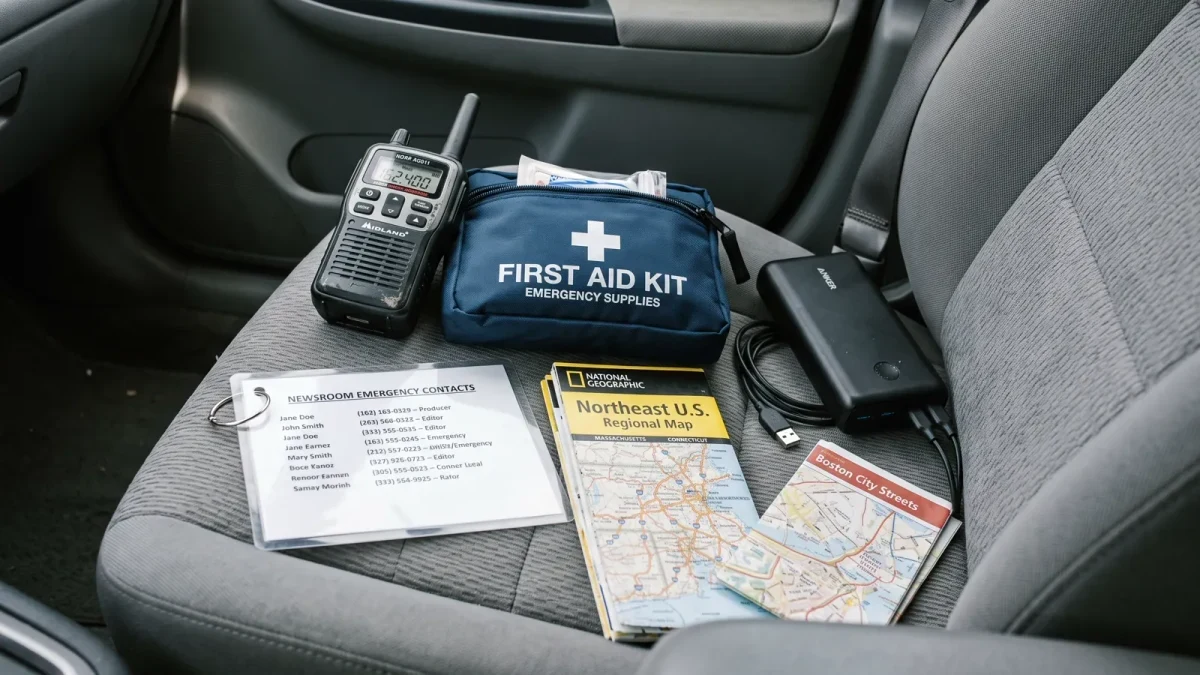
Weather-emergency reporting is won before the weather: the outlets communities rely on during floods, fires, and storms prepare the checklist in calm conditions — gear, sources, templates, and a distribution plan that assumes the power is out. The Federal Emergency Management Agency's guidance and the National Weather Service's alerting products define the information backbone, but the reporting layer around it is the local newsroom's job alone. Residents in a disaster need four things: what is happening, what to do, where to go, and when it will be safe — and they need it on channels that still work.
What gets prepared before the season?
- The emergency kit: charged battery packs, a car inverter, printed contact lists, a battery or hand-crank radio, offline maps, first aid — and the same kit duplicated in a second reporter's car.
- The source list: emergency manager, county engineer, school superintendent, utility spokespeople, shelter operators, and one contact at the National Weather Service office that covers the county — verified quarterly, printed.
- The templates: pre-written explainers — how evacuation orders work, what a boil-water notice means, how to document damage for insurance — ready to localize and publish in minutes.
- The distribution plan: the SMS list tested, the radio partnership confirmed, the print contingency understood — who prints, and where papers get dropped when roads close.
- The staffing map: who covers what, where everyone sleeps, and the rule that no reporter self-deploys into danger.
What does coverage during the event look like?
Service first, narrative later. The running live coverage answers the four questions continuously, timestamped, with every claim attributed to the official source that said it — during disasters, wrong information travels faster than floodwater, and the outlet's discipline is the community's. Verify before amplifying: road closures and shelter openings change hourly, and the standing check is a call to the operating source before publishing. And cover the official response critically even mid-event: the evacuation zone that excludes a neighborhood, the shelter that is not open when announced — those are accountability stories that must be told in real time because they are the moments the harm happens.
How do you publish when the infrastructure fails?
The assumption of failure is the plan's spine. Text alerts reach phones when data does not; the radio partnership carries audio when sites are down; and the physical drop — papers at shelters, feed stores, and the volunteer fire department — reaches the residents the digital plan always misses. Several newsrooms hardened by repeated storms publish a laminated one-sheet with emergency numbers and frequencies, distributed before the season, that bears the outlet's name precisely because it is the thing residents keep. Low-tech is not a fallback in a disaster; it is the product.
What about reporter safety?
Non-negotiable rules, briefed before every deployment: never drive through water — the National Weather Service's "turn around, don't drown" applies to reporters as much as anyone; no live positioning in the storm's path; pairs on dangerous assignments; and an editor with the authority to pull anyone out, exercised without debate. The dead-and-missing are covered with trauma-aware practice: families are contacted with the same care as any tragedy coverage, and identifications come only from official sources. A reporter who witnesses destruction works a shift, then gets relief — emergency coverage is a marathon with sprints in it, and burnout casualties are part of the documented cost.
What comes after the water recedes?
The recovery beat, which outlasts the storm by years: who gets aid and who does not, where the rebuilding money goes, why the flood plain map said what it said. The accountability story of most disasters is written in the second month, not the first — and the outlet that stays on it becomes the community's institutional memory of what happened, which is the highest service local journalism performs.
Frequently asked questions
How do we keep the site up when our own office loses power?
Host the site outside the disaster zone, on infrastructure built for it — a managed host, not a server in the back room — and verify failover before each season, not during.
Should we publish unverified rescue requests we receive?
Route them to emergency services immediately and directly — that is the response that saves the person — and publish only what officials confirm. Amplifying unverified pleas can divert scarce resources.
What if officials ask us to hold information?
Genuine operational-security requests deserve consideration and documentation; the default is publication. Record every request, by whom, and the stated reason — the log is both protection and story.