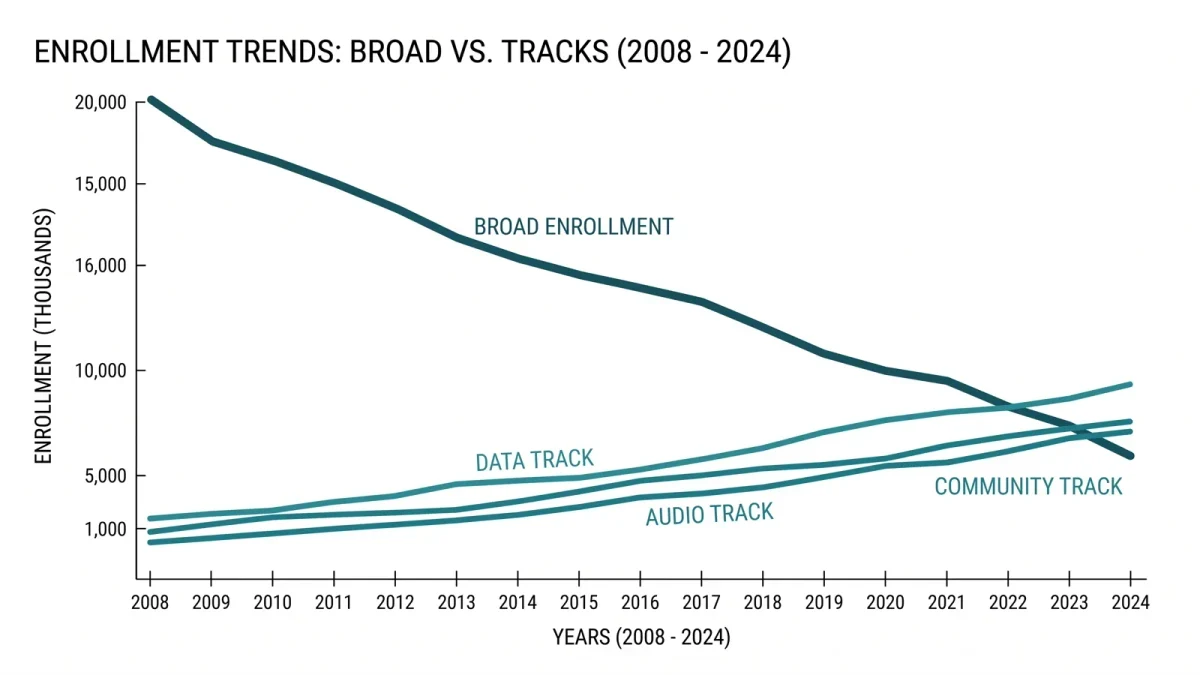
Journalism enrollment in the United States fell sharply after 2008 — undergraduate journalism enrollment declined for roughly a decade as the industry's job market contracted — and the field that has re-formed is smaller and differently shaped: programs report relative strength in data journalism, audio, and community-focused tracks, and in models that put students inside working newsrooms. The University of Missouri's journalism school, the field's oldest, and the professional master's programs at Columbia, CUNY, and Arizona State illustrate both the decline's depth and the adaptation.
What does the new shape look like?
Four patterns recur across program announcements and accreditation discussions:
- Vocational integration: programs built around working newsrooms — CUNY's collaborations with New York outlets, Arizona State's Cronkite News operating as a real bureau serving Arizona media, Missouri's community news partnerships through its local-news initiatives.
- Skills concentration: data and investigative methods, audio production, and product and audience strategy growing while general print tracks shrink. Community-journalism mission: explicit positioning of local news as the field's growth problem — student-powered coverage of underserved communities as curriculum.
- Shorter and cheaper: certificate and master's routes aimed at career-changers, competing with the four-year degree's uncertain return.
Why did enrollment fall, honestly?
Because the signal was clear for over a decade: newsroom employment fell by about half from its mid-2000s peak — U.S. newsroom employment dropped from roughly 114,000 in 2008 to near 85,000 by the early 2020s, per Bureau of Labor Statistics data — and prospective students read the coverage. The follow-on effect on diversity is the part the field discusses least: as programs contracted, the pipelines that had begun diversifying newsrooms contracted with them, making the newsroom-diversity problem an enrollment problem too.
What is the hiring market now telling students?
A split market. Legacy metro newsroom openings remain scarce and contested; the growth edges are local nonprofit newsrooms, collaborative statewide bureaus, audience and product roles, and independent outlets launched by veterans. The skills in observable demand pair reporting fundamentals with data handling, audio, or audience analytics — and, at small outlets, the whole skill stack at once, which is why programs teaching one-person-bureau workflows report strong placement into local jobs.
What does this mean for a working newsroom editor?
Three practical uses. Recruit directly from the integrated programs — the student who has filed for a real outlet under a real editor needs no onboarding sermon on deadlines. Second, build the partnership yourself: statehouse and community coverage partnerships with a J-school convert one faculty supervisor and a dozen students into a bureau, a model several statehouse reporting partnerships now run on. Third, read the enrollment trend as market intelligence: what programs teach this year is the candidate pool in two years, and the shift toward data and community tracks is the clearest signal of where the field's next staffing normal lies.
Is the two-year decline story over?
The honest reading: the collapse phase is over; stabilization at a lower level is the current fact. Some programs report application growth in mission-driven tracks even as overall numbers stay below their 2000s peaks — and the industry's own restructuring, with nonprofit and local launches partially offsetting legacy cuts, has made the employment picture less monolithic than the one that scared students away. The durable question is not enrollment volume but whether the new, smaller pipeline reaches the communities that lost coverage fastest.
Frequently asked questions
Is a journalism degree still worth it?
For the network, the newsroom practice, and the mentored bylines, often yes — especially in the integrated programs. For the credential alone, less: portfolios hire in this field.
Are international students part of the shift?
Yes — graduate programs in particular enroll substantial international cohorts, and visa policy changes have been a live instability for both students and programs.
Can newsrooms influence curricula?
Yes, through advisory boards and paid internship pipelines — the programs most responsive to working editors are the ones built around them.