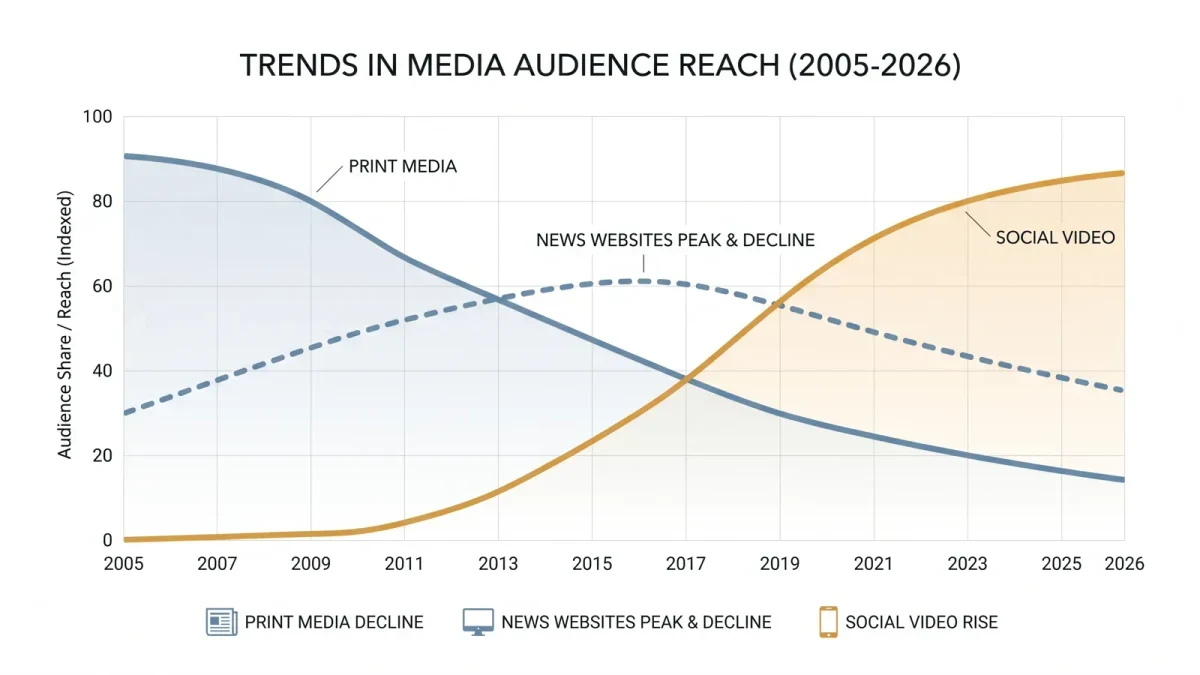
The 2026 Digital News Report, published in June 2026 by the Reuters Institute for the Study of Journalism at the University of Oxford across its annual multi-country sample, describes a second wave of platform displacement: the first wave of social media growth hit newspapers hardest, and the new wave is affecting news organizations' video and website interests as audiences shift further toward social and video environments. The report's executive summary frames the pattern directly — and trade coverage of the findings, including Nieman Lab's June 2026 analysis, put it plainly: news sites are becoming the new newspapers, abandoned as destinations just as print was.
What did the 2026 findings show?
Per the report's executive summary and published coverage: continued audience decline for traditional and destination news products across markets; growth in news access through social video and creator-mediated environments; and the accompanying economics — U.S. traffic data for mid-2026 showed only a handful of the fifty biggest news sites posting year-on-year growth in June, per Press Gazette's monthly ranking. The Institute's long-run trend lines — trust fragmentation, news avoidance, platform-by-platform consumption — continue in the directions the previous editions documented, with the destination-site decline now explicit enough that the report's own framing names news organizations' web and video interests as the exposed layer.
What does "second wave" mean practically for a newsroom?
That the channel strategy newsrooms built in the 2010s — a good website, assumed to be permanent infrastructure — is now the layer under pressure, exactly as print was in the 2000s. The practical consequences the report's data supports: destination traffic declines even where loyalty holds; video and off-platform formats increasingly mediate the first contact with journalism; and the outlet's owned channels — email, text, app habit — are the only assets whose usage the wave does not reduce. None of that argues for abandoning the site; all of it argues for treating site traffic as a maturing asset rather than a growth assumption.
What should editors actually do with this?
- Re-weight the owned stack. Email and SMS metrics move to the top of the dashboard; site pageviews become a secondary indicator, read as archive demand and search service.
- Meet video honestly or not at all. The report documents where the audience is; it does not oblige every outlet to chase it. Outlets without video capacity serve their audience better through audio and text excellence than through thin video presence — the failure mode is imitating formats the newsroom cannot sustain.
- Watch the survey's trust and avoidance lines for the newsroom's own market: avoidance driven by negativity and overload is the actionable finding for most local outlets — shorter, calmer, more service-shaped products respond to it directly.
- Cite the report precisely: country samples, indicators, and years. The DNR is the field's most-cited dataset, and loose citation of it — a global aggregate applied to a local market — is itself a small credibility error.
What are the report's limits?
Worth saying in the same breath: the survey samples and online populations differ by market; aggregates hide wide national variation; and the report measures consumption and attitude, not journalism's effects. The annual wave of June coverage tends to flatten the findings into one doom line — practitioners reading the full country chapters consistently find more useful, more local variation than the headlines carry.
Frequently asked questions
Is the destination website dead?
No — declining as a share of first contact, still essential as archive, search surface, and the home of owned-channel signup. The pattern is maturation, not extinction, and mature assets are managed differently, not mourned.
Does this mean every newsroom needs a video strategy?
It means every newsroom needs a considered answer. Video-first platforms are where growth sits; a newsroom without video capacity makes a deliberate choice either way, documented in its strategy, rather than drifting.
Where can the findings be read?
The Reuters Institute publishes the report and its executive summary openly at its Oxford site, with country chapters and methodology — the primary source to cite before any secondary coverage, this piece included.