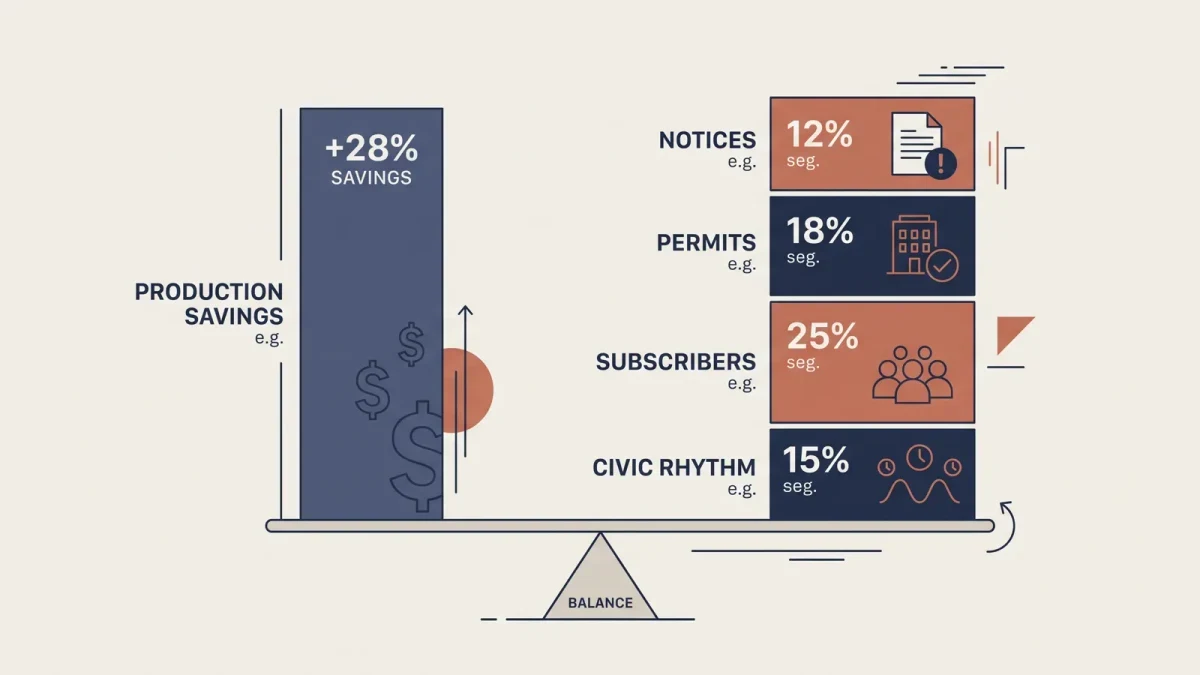
Cutting a print day makes financial sense when three conditions hold together: the day's advertising and circulation revenue no longer cover its production and distribution cost, the remaining days still meet the frequency thresholds that state legal-notice statutes and postal periodical permits require, and the newsroom can keep the promise it makes to subscribers about what they are buying. The decision looks like a production choice and is actually three promises being renegotiated at once — with readers, with government, and with the paper's own identity.
What is the actual saving?
Production economics reward density: presses, plates, trucks, and insertion labor are largely fixed per run day, so removing a day removes a whole slice of cost while the remaining runs absorb little of it. Newsroom analysis of newspaper cost structures has long shown production and distribution, not journalism salaries, dominating small-paper expense — which is why cut days and shared printing arrangements are the two moves that preserve reporting headcount. But the saving is only the visible half of the ledger, and the visible half is what makes the decision easy and wrong.
What are the quiet costs?
Four, in rough order of how often they are missed:
- Legal-notice eligibility: many U.S. state statutes define a qualified publication by minimum frequency and circulation; dropping below the line can disqualify the paper from notice revenue entirely. The state's statute must be read before the calendar is cut — this check alone changes many decisions.
- Postal permits: periodical-class mailing carries its own frequency requirements; a misstep here raises every remaining issue's delivery cost.
- The subscriber promise: a seven-day subscriber bought seven days. Cutting silently converts a price increase into a trust problem; cutting with an honest repricing and a choice is survivable, and the difference is entirely in how it is communicated.
- Civic rhythm: the Tuesday paper is when a community's agenda notices and sports roundups ran. Some of that moves to other days; some of it simply disappears from the lives of the readers who plan around print — the same low-connectivity readers rural distribution analysis keeps identifying as print-dependent.
How should the decision be run?
As a review, not a reaction:
- Cost the day honestly: production, distribution, and editorial time specific to that day's run.
- Check statutory thresholds — legal notices and postal — before anything else; a disqualifying cut is a different decision entirely.
- Model notice revenue under the new schedule, including the risk that advertisers consolidate into fewer, pricier days.
- Plan the reader communication: price adjustment, what moves where, and a human answering the phone the week it lands. Announce it weeks ahead, in print.
- Protect the freed money: commit the saving to journalism headcount explicitly, and say so publicly — the cut buys something, and readers should hear what.
Which day is the right day?
The one with the least unique function. Saturdays are the common first cut — lighter ad demand — but the right answer is local: audit which day carries the most legal notices, the most subscriber-relied content, and the strongest single-copy sales. The mistake is cutting by industry habit rather than by the market's own pattern, and the audit takes an afternoon against the paper's own books.
Is the endgame going all-digital?
For metro dailies, mostly already answered. For community weeklies and small dailies, the honest projection is a durable print tail: print remains the universal channel in low-connectivity and older-skewing markets, and paid print subscribers still fund a large share of small-outlet revenue. The strategic question is not print versus digital but which print days earn their cost while the digital products grow — and the outlets that treat each print day as a product with its own P&L tend to make the calls calmly, years before the bank makes them instead.
Frequently asked questions
How many days can you cut before subscribers revolt?
Fewer than the arithmetic suggests. What triggers revolt is silence and unadjusted pricing, not the cut itself — outlets that repriced honestly and explained the statutory and cost drivers kept most subscribers through multi-day reductions.
Does cutting days affect advertising rates?
Usually upward per insertion as remaining days densify, but total ad revenue often dips before it recovers. Model the consolidation effect with advertisers, not just internally.
What if the state changes its notice law afterward?
Then the decision reopens — which is why the cut day analysis, and the paper's coverage of notice-law legislation, belong in the same editor's head.