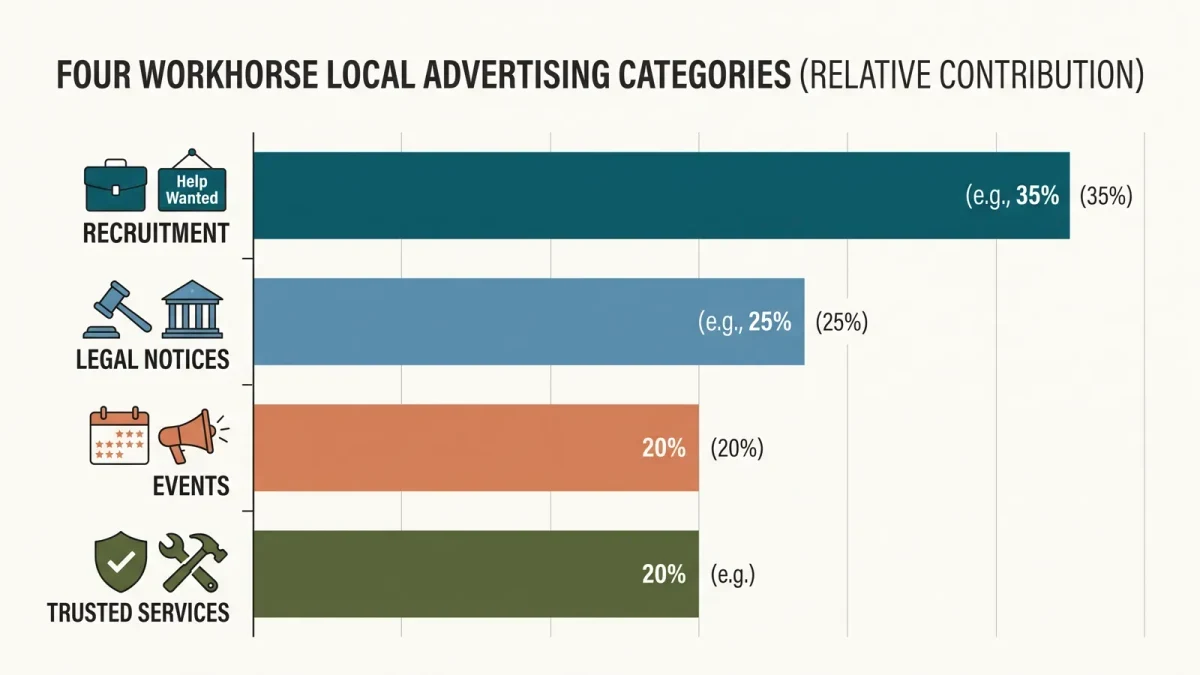
Local advertising still pays where the ad itself does a job the buyer can measure: a filled position, a filed legal notice, a sold-out event. The categories that reliably produce revenue for small independent outlets are recruitment, legal and public notices, events and entertainment, and high-trust services — plumbing, roofing, funeral homes, elder care — sold at real rates against outcomes. Open-market programmatic display, by contrast, has collapsed to fractions of a cent per thousand impressions; the U.S. local advertising market overall has been tracked for years by BIA Advisory Services, whose annual forecasts show national platforms absorbing the growth while direct local spend concentrates in a few workhorse categories.
This publication covers revenue practice; it is not business advice, and ad rates depend on each market.
Which categories pay, and why?
- Recruitment: a help-wanted reader is worth more than a banner viewer, and small outlets can price job postings against the cost of a bad hire, not against CPM.
- Legal and public notices: in many U.S. states, statutes still require publication in a qualified local outlet. Where those laws hold, notices are the most defensible line item a small outlet has — and where legislatures weaken them, that revenue is a political story as much as a business one.
- Events: fairs, festivals, and school sports schedules bundle advertising with content the audience actually wants, and the buyer sees the ticket sales.
- High-trust services: trades and care services buy the audience's trust in the masthead, which is the one asset a local outlet has that a platform never will.
How should a small outlet price?
Stop selling space; sell packages with proof. A workable unit is a month-long bundle — a listing, a story-adjacent placement, a newsletter mention, and a simple report of calls, clicks, or coupon redemptions at the end. The report is the product: the advertiser renews against evidence, not against affection for local news. Outlets that publish rate cards anchored on flat monthly packages report dramatically less churn than those selling impressions, because impressions are a comparison a local buyer cannot win.
What is the honest case to advertisers?
Reach quality. A local outlet's audience is geographically exact in a way no platform targeting can match — every reader is in the market, by definition. That argument works best with a media kit that shows the audience plainly: circulation or monthly readers, geography, and one or two engagement numbers. Ethical guardrails belong in the same kit and in the sales script: advertising never buys coverage, sponsorships are labeled, and the wall between the sales conversation and the news desk is written into the outlet's standards.
What should a newsroom refuse?
Categories that rent the masthead's credibility to claims the newsroom cannot stand behind: miracle health products, political campaign ads presented as editorial features (where law permits refusal), and any arrangement that trades ad spend for coverage promises. One bad-faith advertiser costs more trust than the revenue is worth, and trust is the inventory the whole model sells.
How much of the budget should advertising be?
For most small independents, the healthy direction is diversification: reader revenue and grants rising, advertising stabilized rather than grown. The outlets that survived the programmatic collapse best treated advertising as one leg among three or four — resilient in exactly the way single-leg operations were not, as the last decade of local closures has documented.
Frequently asked questions
Are legal notices really safe revenue?
Where statute requires them, yes for now — but they are politically exposed, since legislatures periodically move notices to government websites. Smart outlets cover that debate as news and plan revenue without counting notices as permanent.
Can a two-person newsroom run ad sales at all?
With packages and a calendar, yes. Fixed inventory published on a rate card turns sales into order-taking; custom deals are what consume editorial time.
Does accepting government ads compromise coverage?
Not if disclosure and the wall hold: government is a legitimate advertiser in many markets, but the arrangement should be public and the coverage of that agency unaffected — and seen to be.