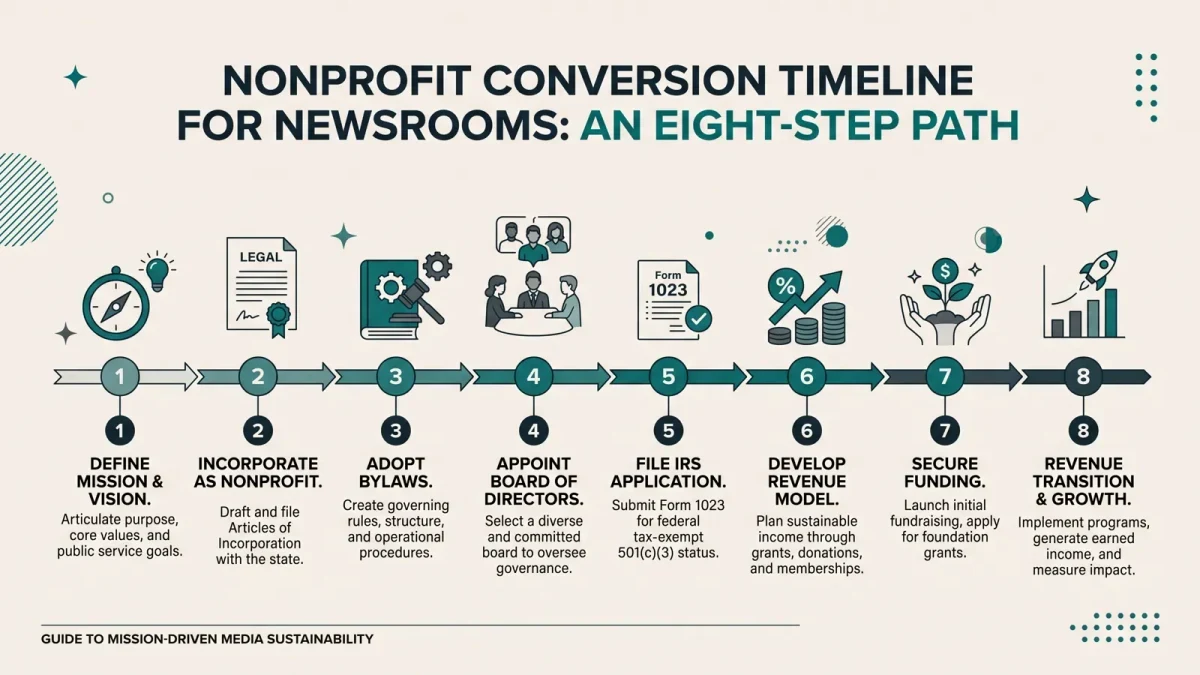
Converting a local newsroom to nonprofit status in the United States is an eight-step process that typically runs six months to a year, and the first step is not paperwork — it is deciding that the mission, not the tax table, is the reason. The Internal Revenue Service has accepted journalism organizations under section 501(c)(3) for years, and published accounts from newsrooms that made the switch agree on the sequence: mission and governance first, entity and applications second, revenue transition last. Skipping to the forms produces a nonprofit with no donors and a board of the owner's relatives.
This publication covers the process as journalism business practice; it is not legal or tax advice. Every step below needs professional review in the newsroom's own jurisdiction.
What are the eight steps?
- Write the mission statement in educational terms. 501(c)(3) recognizes charitable and educational purposes; "informed community" language, not "profitable newsroom" language.
- Build an independent board. At least three unrelated directors, no concentrated family control, and a documented conflict-of-interest policy — the IRS asks, and funders ask harder.
- Form the entity. Incorporate as a nonprofit corporation in the state, with bylaws that keep editorial independence explicit.
- Obtain the federal EIN and register for state charitable solicitation where the newsroom will fundraise.
- File IRS Form 1023 (or the shorter 1023-EZ where eligible) and wait — processing times vary, and the application narrative should describe journalism as community education.
- Transfer or wind down the for-profit. Assets can move to the nonprofit at fair market value; staff contracts, contracts with advertisers, and leases need review so nothing is left stranded in the old entity.
- Set up the donor and accounting infrastructure — a donor database, fund-accountable bookkeeping, and receipts that acknowledge tax-deductibility correctly.
- Transition revenue deliberately. Advertising can continue under the nonprofit in unbranded, non-endorsement forms; sponsorship language and rates change, and major funders apply through grants to the new entity.
What does conversion change editorially?
Nothing, and that must be visible. The most durable conversion documents pair the nonprofit application with an editorial-independence policy: funders are disclosed, no funder receives advance review, and coverage decisions rest with the editor. The Institute for Nonprofit News requires exactly this kind of independence and transparency from its members, and its published standards are a workable template for a newsroom writing its first policy.
What does conversion change financially?
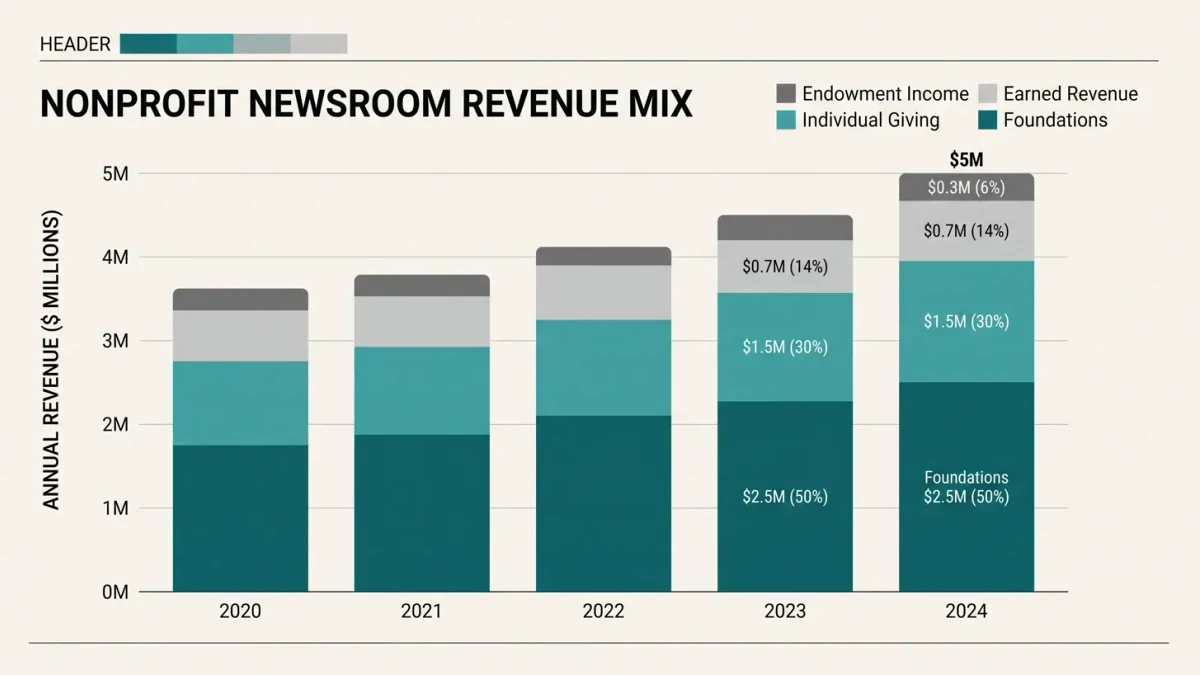
The revenue ceiling rises and the floor gets firmer. Grant funding and tax-deductible individual giving open immediately; matching-gift programs and foundation grants that exclude for-profits become available. In exchange, the newsroom takes on real compliance costs: annual information returns, audit expectations from larger funders, and state registration renewals. Small outlets frequently underestimate the bookkeeping — a working planning figure used in the field is that compliance adds a low five-figure annual cost before any accountant's mishaps.
What are the common failure points?
Three recur in published post-mortems of failed conversions. A board that exists only on paper, which funders detect in one diligence call. An independence policy written after the first funder conflict instead of before. And the assumption that donors arrive with the status letter — they do not; the fundraising program a newsroom ran as a for-profit is the one it will need as a nonprofit, only now with receipts.
Frequently asked questions
Can a for-profit newsroom accept donations instead of converting?
It can accept gifts, but they are not tax-deductible and most grants are closed to it. Fiscal sponsorship — operating journalism under an existing nonprofit — is the middle path many outlets use for a year before converting.
Does nonprofit status ban advertising?
No. It bans political endorsement and restricts unrelated business income, not advertising per se. Many nonprofit newsrooms sell sponsorships and underwriting within IRS limits.
How long before grant money actually arrives?
Commonly six to eighteen months after approval, because foundation cycles are annual. Converters should hold enough operating reserve to cross that gap on reader revenue alone.